


How to Create a Booking Flow That Qualifies Better Leads

Sep 29
10 min read

An open calendar is not a sales strategy.
If everyone receives the same link, books the same call, answers questions nobody reviews, and arrives with a different idea of what the meeting is for, the calendar becomes a sorting department. The business owner spends the first half of each conversation discovering that the person needs another service, is not ready for the decision, expected free consulting, or should have received a resource instead of a meeting.
The frustration usually gets blamed on lead quality. Sometimes the lead was never the problem. The booking flow failed to explain, screen, route, and prepare.
A better flow does not create a wall around your calendar. It creates the right door. Appropriate prospects can move with less friction. People who need something different receive honest direction. You enter the call with enough context to spend the time on the decision instead of rebuilding the entire customer journey in thirty minutes.
In the ABCS framework, booking sits between Build and Convert. The relationship has created enough interest for a conversation. The booking flow helps determine whether that interest has become a qualified prospect and prepares the conditions for a useful decision.
If the larger funnel is losing people before or after the calendar, use Why Your Leads Aren't Turning Into Clients to identify the weakest handoff before changing the booking tool.
How to Create a Booking Flow That Qualifies Better Leads
Start with the meeting, not the software. A calendar tool can display availability, collect answers, and send reminders. It cannot decide what the call should accomplish, which answers matter, or how the business should serve someone who is not ready to book.
The strongest flow makes five decisions before anyone chooses a time. I call this the READY Booking Flow.

The READY Booking Flow defines the right meeting, essential questions, appropriate routing, defined commitment, and yield data.
Choose the Right Meeting
Name the meeting according to the decision it supports. A discovery call, consultation, assessment, strategy session, and client support call are not interchangeable. Each has a different purpose, level of preparation, and expected outcome.
The page should explain what the person will discuss, what they should leave understanding, and what the call is not. If the meeting is a fit conversation for a six-month coaching program, say so. If it is a paid diagnostic that includes recommendations, do not disguise it as a free discovery call. Clarity attracts people who want the actual conversation and discourages people seeking a different one.
Collect Essential Information
A useful booking form collects the minimum information required to route, prepare, and serve. It is not a full client intake, a personality assessment, or an attempt to complete the sales call before it begins.
The right questions reveal the person's goal, current situation, urgency, prior action, and intended type of support. Each answer should change something the business does. If the answer will not be reviewed, stored, routed, or used, remove the question.
Create Appropriate Routes
Not every interested person should see the same calendar. Clear-fit prospects may book directly. A complex request may need manual review. A relevant person who is too early may benefit from an educational resource or community. A need outside your scope should receive an honest referral or alternate direction.
Routing is part of service. It saves the prospect from preparing for a call that cannot help them and saves the business from using valuable time to deliver information that could have been communicated before the meeting.
Define the Commitment
A booking is a small agreement. The business protects the time. The prospect provides accurate information, prepares, attends, and follows the rescheduling or cancellation policy. The confirmation page, calendar invitation, emails, and text reminders should all support that agreement.
Use Yield Data
Do not judge the flow by how many names appear on the calendar. Review what those appointments produce. A lower booking rate can be healthier when the show rate, fit rate, decision quality, and close rate improve. The goal is not to make the calendar look busy. The goal is to create better conversations with people the business can serve well.
Design the Entire Path Before the Booking Page
The calendar is only one stage. The message before it and the communication after it determine whether the appointment becomes useful.

A qualified booking flow connects message, meeting purpose, intake, routing, protected availability, preparation, and recorded outcomes.

If a visitor arrives at the booking page without understanding the offer, a longer form will not repair the message. If the calendar promises a strategy call but the host treats it as a screening call, reminders will not repair the expectation. Work from the promise forward.
Write a Booking Page That Qualifies Before the Form
Qualification begins in the copy. The page should help a thoughtful visitor decide whether the meeting fits before they complete a field.

A clear service statement improves this page before any automation is added. Use How to Write a Service Statement That Sells to sharpen the buyer, problem, result, and consequence language that brings appropriate people to the calendar.
Ask Questions That Change a Business Decision
Long forms do not automatically produce qualified leads. They often produce abandoned forms, rushed answers, and paragraphs the host does not have time to read. The form needs enough information to make a better decision and no more.

A booking-form question belongs when the answer changes routing, preparation, or service.

Use required fields sparingly. Contact details and the few responses needed to assess fit may be required. A detailed narrative, optional context, or information the prospect may not have yet can remain optional.
Do not request sensitive personal, financial, health, legal, or confidential business information through a general booking form unless it is necessary, expected, protected, and handled according to the laws and professional standards that apply. Qualification does not require collecting everything a person knows about themselves or their company.
Handle Budget and Readiness Without Turning the Form Into a Test
Budget questions can improve routing when the offer range is clear and the answer changes the path. They become manipulative when the price is hidden, the options are designed to shame the prospect, or every answer receives the same sales call anyway.
A better approach is to state the investment range or starting point near the form, then ask which option best reflects the person's current planning. Use language such as, "If the conversation confirms a fit, which investment range are you prepared to consider?" Include an option for a person who needs a resource before a sales conversation. That answer should lead somewhere useful.
Readiness is larger than budget. A person may have funds but no decision authority, no implementation capacity, or no intention of changing the current system. Another prospect may need a smaller offer that creates a responsible bridge. Ask about the factors that affect the actual engagement, not merely the amount in the bank.
Route Every Response With Respect
A qualification form should never end with a cold rejection message that treats the person like bad data. The route should explain what happens and provide the most useful available direction.

A respectful booking flow routes clear-fit prospects to booking, complex requests to review, early-stage leads to readiness support, and out-of-scope needs elsewhere.

Calendly's current Routing Form guidance allows responses to send qualified visitors to an event type and other visitors to a custom message or external URL. Review the official routing-form setup before building logic. HubSpot also documents conditional form redirects that can send people to different scheduling pages or destinations based on submitted information.
Protect the Calendar Without Making It Difficult to Book
A qualified prospect should not have to exchange six emails to find a time. Calendar protection comes from clear rules, not unnecessary delay.

Wix currently supports custom booking forms for different services and allows appointment requests to require approval in eligible configurations. Review the official booking-form guidance and approval limitations before choosing the flow.
Prepare the Prospect After the Booking
Qualification continues after the time is selected. A strong confirmation helps the prospect understand the meeting, arrive prepared, and recognize that the business is ready for the conversation.
Confirm the meeting name, date, time, time zone, duration, host, and meeting location
Restate the purpose in one clear sentence
Name the two or three items the prospect should have available
Include the rescheduling and cancellation policy in plain language
Provide a direct reschedule or cancel link when the platform supports it
Explain how to submit any required material securely
Tell the prospect where to send a question before the meeting
Do not bury the joining link below a promotional essay. Do not send five unrelated case studies because the person booked. Preparation should make the call more useful, not give the prospect another assignment to manage.
Use Reminders to Reinforce the Agreement
A reminder is not merely a date notification. It can restate the purpose, reduce uncertainty, and provide a responsible way to release the time when the person cannot attend.

Calendly and Wix both document automated pre-meeting communication options. Review Calendly's current Automations guidance for email and text reminders, then verify the platform plan, consent requirements, timing, and message settings before relying on automation.
Keep the Intake Answers Visible in the CRM
The value of a qualification form disappears when the answers remain trapped inside the calendar tool. Store the information where the person responsible for the conversation can review it and where the business can learn from it later.
Original lead source and referral detail
Meeting type and booking date
Goal, stage, timing, and support preference
Qualification route and reason
Attendance status
Fit decision and relevant offer
Follow-up owner and due date
Proposal, client, revenue, or alternate outcome
LaShay's ABCS teaching separates a lead from a prospect. A lead is contact information. A prospect is someone the business has qualified and can serve with a relevant offer. The booking flow should preserve the evidence that supports that distinction instead of labeling every scheduled name as sales-ready.
Once the conversation happens, use How to Follow Up After a Discovery Call Without Feeling Like You Are Chasing to create the communication that carries the decision forward without relying on memory or mood.
Measure the Flow Beyond Booked Calls
A calendar full of appointments can hide a weak funnel. Measure the stages in order so you can see where the path is helping and where it is wasting time.
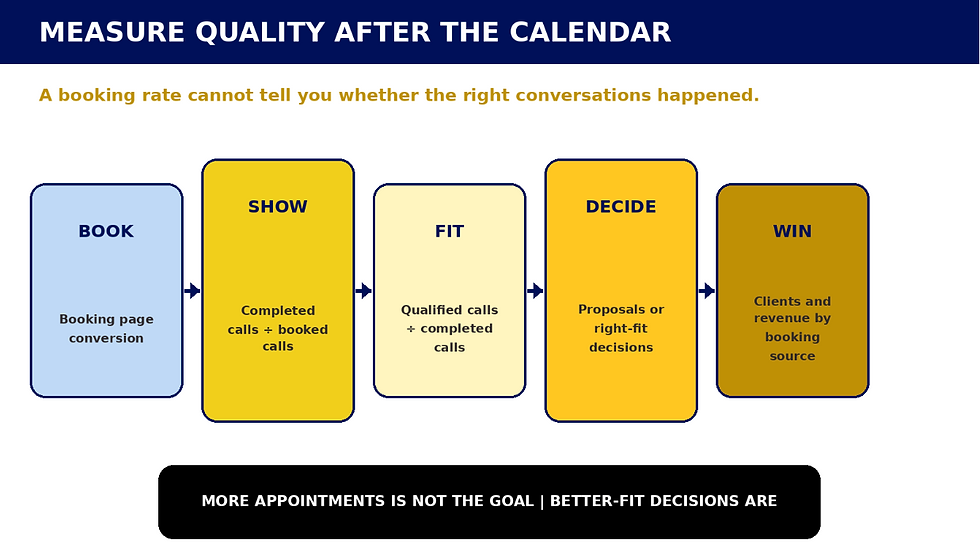
Booking-flow measurement should move from booking completion through attendance, fit, decision, and revenue.

Google Analytics allows a confirmation-page event to be created from a page view and marked as a key event. Use the official event creation guidance to measure completed booking confirmation, then connect that event to attendance, fit, and CRM outcomes rather than treating confirmation as the final result.
Review the numbers by meeting type, lead source, offer, and host. A form may look healthy overall while one referral source produces excellent-fit calls and one paid campaign produces repeated no-shows. Aggregate data can hide the business decision.
A Before-and-After Booking Flow Example
Consider an operations consultant who offers a thirty-minute discovery call. The original page says, "Let's chat," displays every available weekday, and asks for a name, email address, and one broad question. Anyone can book. The confirmation contains a video link and nothing else.
The consultant receives a mixture of startup questions, vendor pitches, requests for free troubleshooting, and established business owners with genuine operational gaps. She spends ten minutes identifying why each person booked and another ten explaining what she does. Several prospects arrive without access to the information needed for a meaningful conversation.

The improved flow does not guarantee a sale. It creates a fairer and more useful conversation. The consultant knows why the person booked. The prospect understands the purpose. People who need a different resource are helped before an unnecessary call. The sales conversation can focus on fit, implications, and the appropriate decision.
Common Booking Flow Mistakes
Sending every website visitor directly to the same calendar
Calling the meeting a strategy session when no strategy will be provided
Using vague copy that attracts people seeking a different service
Adding questions because the software allows another field
Collecting answers that nobody reviews before the call
Making budget the only definition of readiness
Rejecting early-stage leads without a useful alternate path
Leaving the calendar open without notice periods, buffers, or daily limits
Sending reminders that contain logistics but no purpose or preparation
Failing to store intake answers and call outcomes in the CRM
Counting booked calls while ignoring no-shows, poor fit, and source quality
Audit the Booking Flow in Five Passes
Pass 1 Clarify
Write the meeting purpose, appropriate buyer, decision, boundaries, duration, and possible outcomes.
Pass 2 Qualify
Apply the decision-changing question test. Remove every field that does not affect routing, preparation, or service.
Pass 3 Route
Define what happens for clear fit, manual review, early readiness, out-of-scope requests, and unmatched responses.
Pass 4 Protect
Set availability, buffers, notice, booking limits, approval, payment, policies, confirmation, and reminders.
Pass 5 Learn
Record source, answers, attendance, fit, decision, follow-up, client outcome, and revenue. Review the complete path each month.
Frequently Asked Questions About Qualified Booking Flows
What is a qualified lead booking flow?
It is the connected path that explains the meeting, collects decision-changing information, routes each person to an appropriate destination, protects availability, prepares the prospect, and records what the conversation produces.
How many questions should a booking form include?
Use the fewest questions needed to route and prepare well. For many service businesses, four to six thoughtful qualification questions plus contact details are sufficient. The answer depends on the complexity, risk, and commitment of the meeting.
Should pricing appear before someone books a discovery call?
Show a starting point, range, or clear investment expectation when price materially affects fit and the offer structure allows it. Do not hide required investment and then use the call to surprise the prospect.
Should every lead be allowed to book immediately?
No. Direct booking works for clear-fit requests. Manual review can protect complex, limited-capacity, regulated, or specialist services. Early-stage and out-of-scope leads should receive a respectful alternate route.
How do I reduce no-shows for discovery calls?
Set a clear purpose, require a proportionate commitment, send immediate confirmation, provide preparation guidance, use timed reminders, include a rescheduling route, state the policy, and follow up consistently after cancellations or missed calls.
What should I track in a booking flow?
Track booking-page visits, form starts, completed bookings, show rate, qualified-call rate, program fit, decisions, proposals, clients, revenue, source, cancellations, and no-shows.
Build a Better Door, Not a Higher Wall
A booking flow should protect your time without making appropriate prospects prove their worth. The standard is service and fit.
Name the meeting. Ask what changes the decision. Route each person responsibly. Prepare the conversation. Review what the calendar produces after the appointment is over.
That structure gives qualified prospects a cleaner path and gives your business better evidence. You stop measuring success by how many people gained access to your calendar and start measuring whether the right people received the right conversation at the right time.
Build relationships before the booking link: Join the BOLD Network to grow inside a faith-centered business community where visibility, referrals, strategic conversations, and trusted relationships help appropriate people understand your work before they reach your calendar.
About the Author
LaShay LaRue is the founder of Cherished Investments and a business coach, marketing strategist, and systems architect for service-based entrepreneurs. With more than a decade in business development, she helps coaches, consultants, creatives, and clinicians turn expertise into clear offers, sales funnels, content systems, and operations that support consistent growth. Her work is rooted in faith, service, stewardship, and the belief that structure creates freedom.


Comments