


Your Audience Needs to Know Your Business, Not Just Your Brand

Apr 21
7 min read
Updated: May 8
Your audience has been following you for months. They have saved your posts. They have read your emails. They have watched your videos and nodded along. And then someone else announces a similar offer at a similar price — and they buy from that person instead.
That is not a pricing problem. It is not a follower count problem. It is a depth problem.
Your audience knows your brand. They recognize your aesthetic, your phrases, your content pillars. But knowing a brand and knowing a business are two different things. When someone decides to hire a coach, consultant, or service provider, they are not buying the brand. They are buying their confidence that this specific person can actually solve their specific problem. And if they cannot see inside your business well enough to build that confidence, they will give their money to someone who let them in.
That is what content depth is for. Not more content. Not better aesthetics. Not a higher posting frequency. Depth.

The Difference Between Visibility Content and Authority Content
Visibility content is designed to be found. It is shareable, searchable, and optimized for reach. Tips, how-to posts, quick wins, trending audio, relatable memes — these serve a real purpose. They put your name in front of people who have never heard of you. They grow your audience. They keep the algorithm satisfied.
Authority content is designed to be trusted. It is specific, substantive, and optimized for conversion. It shows your thinking, your process, your results, and your perspective on things that matter in your industry. It gives someone enough signal to decide — yes, this is the person I want to work with.
Most service-based entrepreneurs are producing a lot of visibility content and almost no authority content. The result is an audience that grows but does not convert. Followers who enjoy the content but do not buy. Discovery calls from people who were not quite the right fit — because the content attracted curiosity instead of conviction.
The fix is not to stop producing visibility content. It is to pair it with the three types of authority content that actually move people from follower to buyer.
The Three Content Types That Build Buying Confidence
Here is how each content type functions, what it builds, and what it cannot do on its own. Understanding the limitations is as important as understanding the value.

Read that table carefully. Notice that no single content type builds everything on its own. Tips create discoverability. Frameworks build credibility. Transparency builds relationship. Client stories build conviction. You need all four in rotation — not as a rigid formula, but as an intentional mix that gives your audience every signal they need to say yes.
Educational Content: Teaching in a Way That Actually Positions You
There is a difference between teaching that builds authority and teaching that just gives information away. The difference is specificity.
Generic educational content says: here are five ways to grow your email list. Authority educational content says: here is the exact opt-in sequence I use with every new client, why I built it this way, and what it consistently produces. One sounds like advice. The other sounds like expertise.
When you teach from a named framework, a documented process, or a real result — you are not just sharing information. You are demonstrating that you have thought about this deeply enough to systematize it. That is what creates the mental shift from 'this person knows things' to 'this person knows how to solve my problem.'
Three ways to add specificity to your educational content:
Name your process. If you have a way you do things — a sequence, a framework, a methodology — give it a name. The ABCS framework is an example. Named processes are more memorable, more citable, and more associated with you than unnamed advice.
Teach from a result, not just a concept. Instead of 'here is why follow-up matters,' try 'here is what happened to my conversion rate when I added a third follow-up email — and why the timing was the key.' Concepts are forgettable. Results are credible.
Include the decision, not just the tactic. Show why you chose this approach over the alternatives. That reasoning reveals your thinking process, which is ultimately what clients are hiring — not just the deliverable, but the mind behind it.
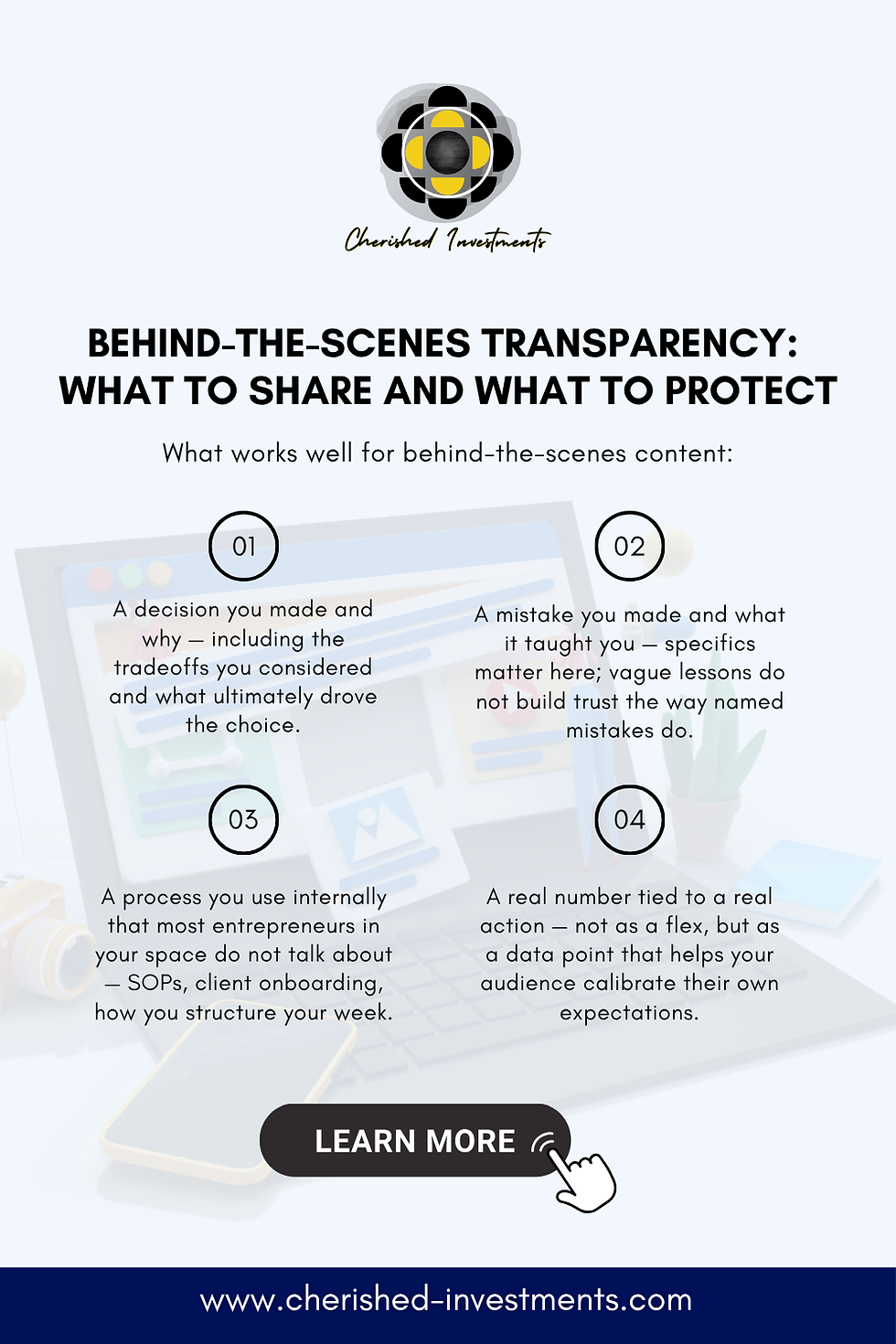
Behind-the-Scenes Transparency: What to Share and What to Protect
Transparency is not the same as oversharing. And it is not the same as performing vulnerability for engagement. Real behind-the-scenes content gives your audience a view into how you actually work — your process, your decisions, your reasoning — in a way that is anchored to a business lesson.
The test for whether a transparency post is worth creating: does it teach something? Does the glimpse behind the curtain lead to an insight your audience can use or apply? If the answer is yes, it belongs in your content mix. If the answer is no, it is lifestyle content — and lifestyle content has a place, but it is not doing authority-building work.
What works well for behind-the-scenes content:
A decision you made and why — including the tradeoffs you considered and what ultimately drove the choice
A mistake you made and what it taught you — specifics matter here; vague lessons do not build trust the way named mistakes do
A process you use internally that most entrepreneurs in your space do not talk about — SOPs, client onboarding, how you structure your week
A real number tied to a real action — not as a flex, but as a data point that helps your audience calibrate their own expectations
What to protect:
Client information and results without explicit permission — even anonymized, be careful about what details identify someone
Financial specifics that could undermine your positioning or invite comparison shopping at the wrong level
Business struggles that have no resolution yet — sharing a problem without a lesson or a path forward creates anxiety in your audience rather than trust

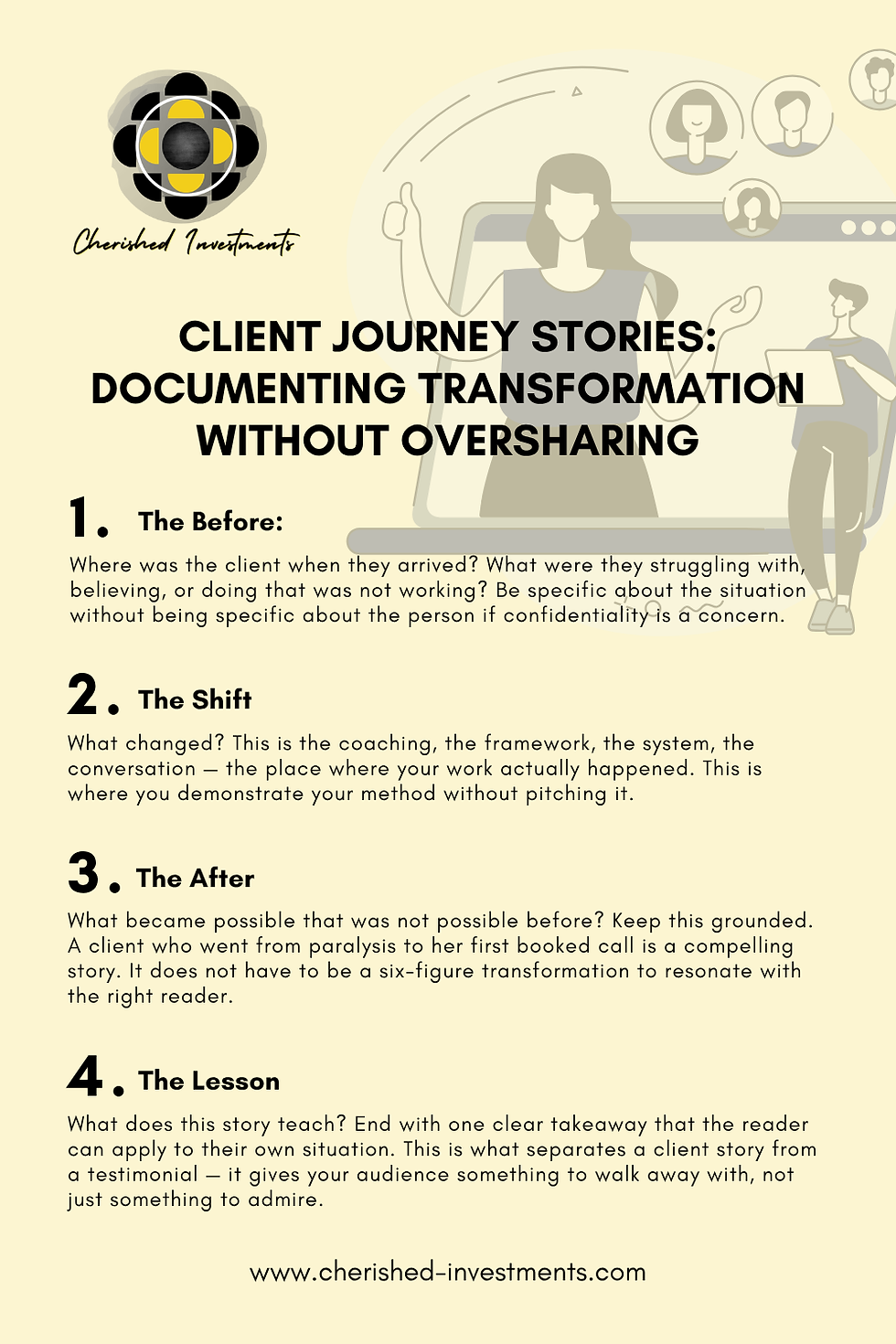
Client Journey Stories: Documenting Transformation Without Oversharing
A client story is the most powerful piece of content you can create — and the most under-used. Most entrepreneurs avoid them because they feel complicated: What if the client does not want to be featured? What if I do not have dramatic results to share? What if it sounds like bragging?
Here is the reframe. A client story is not a testimonial. It is a case study told in narrative form. It does not have to include the client's name. It does not have to feature a revenue number. It just has to be real, specific, and told in a way that lets the reader see themselves in the before.
The structure that works:
The Before: Where was the client when they arrived? What were they struggling with, believing, or doing that was not working? Be specific about the situation without being specific about the person if confidentiality is a concern.
The Shift: What changed? This is the coaching, the framework, the system, the conversation — the place where your work actually happened. This is where you demonstrate your method without pitching it.
The After: What became possible that was not possible before? Keep this grounded. A client who went from paralysis to her first booked call is a compelling story. It does not have to be a six-figure transformation to resonate with the right reader.
The Lesson: What does this story teach? End with one clear takeaway that the reader can apply to their own situation. This is what separates a client story from a testimonial — it gives your audience something to walk away with, not just something to admire.
How to Mix All Three Content Types Into Your Monthly Schedule
Depth does not mean every post is long or heavy. It means every post has a job that goes beyond getting a like. Here is a monthly structure that integrates all three depth content types alongside your visibility content.

This is not a rigid formula. It is a rhythm. Some weeks will shift based on what your business needs — a launch, a timely conversation, a client win that is too good not to share. The structure exists to give you a default so you are never starting from zero.
Why Depth Converts Better Than Volume — Every Single Time
Here is what the data looks like inside most service-based businesses: high posting frequency, low conversion rate. They are everywhere and still getting discovery calls from people who are not the right fit. The problem is almost always the same — the content is broad enough to attract everyone and specific enough to convert no one.
Depth solves this by doing the qualification work before anyone books a call. When your educational content shows your methodology, your transparency content shows your judgment, and your client stories show your results — the people who book a call already know what they are getting into. The fit is established before you say a word.
The table below shows the difference depth makes at the content level. Same topic, same audience, completely different signal.

Every version in the left column will get views. The versions in the middle column will get clients. The difference is specificity, first-person experience, and a named result. That is depth. And depth is what converts.

Look at your last 30 days of content. How much of it showed your process, your real decisions, or your clients' results — not just your tips? That ratio tells you everything about where your audience is in the decision-making process. If the number is low, you do not need to post more. You need to go deeper. Start with one client story this week — even if it is anonymized, even if the result is modest. Tell it with the four-part structure from Section 5. See what happens
About the Author
LaShay LaRue is the founder of Cherished Investments, a strategic business mentoring brand for service-based entrepreneurs. She helps coaches, consultants, creatives, and clinicians build the systems that turn inconsistent revenue into predictable growth. Learn more at cherished-investments.com.



Comments