


How to Batch Content Like a Business Owner, Not a Creator

Apr 14
5 min read
Updated: May 8
You blocked off three hours on your calendar. You made the coffee. You opened a blank document and sat there for forty-five minutes trying to decide what to write about.
That is not a batching session. That is an expensive planning meeting with yourself — except nothing got planned and nothing got created.
Most entrepreneurs approach batching like a creative sprint: carve out a big block of time, show up, and see what happens. The problem is that creativity and strategy do not coexist well in the same two-hour window. Trying to decide what to say and say it at the same time is what kills the session before it starts.
Batching is not a creativity exercise. It is an execution exercise. And execution only works when the decisions are already made.

The Two-Stage Model: Decide First, Then Create
The single shift that makes batching work is separating the thinking from the creating. When you collapse these two phases into one session, you slow both of them down. The strategic brain and the creative brain are not equally useful at the same time. Give each one its own space.
Here is how the two-stage model works in practice.
Here is how the two-stage model works in practice.

Phase 1 feeds Phase 2. You cannot walk into a batching session cold and expect to produce high-quality content efficiently. The content bank you built this week — the one from Tuesday's post on quarterly content planning — is what makes Phase 2 possible. Without the bank, you are back to making decisions in the creation session, and that is where the time goes.


How to Choose Your Quarterly Themes Before You Sit Down to Create
Quarterly themes are the organizing principle of your content bank. They are what makes your content feel coherent to your audience over time rather than a random rotation of topics. And they are what make batching sessions productive — because when you know the theme, half the topic decisions are already made.
There are four types of quarterly themes worth knowing. Choose whichever one fits the season you are in.

Once you have your quarterly theme, choosing your monthly topics becomes straightforward. You are not picking from an infinite list of possible ideas. You are selecting the topics that best serve that theme from the ABCS stage you are prioritizing that month.
April's theme for Cherished Investments is 'Showing Up with a System.' Every post this month — this one included — connects back to that organizing idea. The reader who has been following since Week 1 feels a coherent journey. The reader who finds this post through search gets a standalone piece of value. Both experiences work because the theme creates structure without restricting the individual content.
How to Run a Batching Session That Actually Produces Content
Here is the session structure LaShay uses and teaches. This is not a loose framework. It is a sequence. Follow it in order.
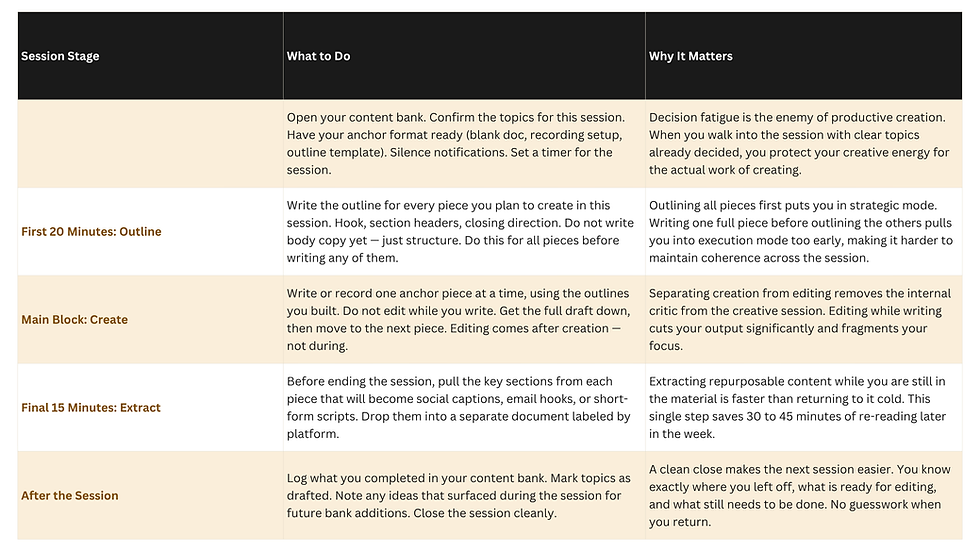
A few non-negotiables that protect the session:
Notifications off. The batching session is not the time to check DMs, respond to emails, or glance at comments. Every interruption costs you 10 to 15 minutes of re-entry time.
No research during creation. If you realize you need to look something up, leave a placeholder and keep writing. Research is a separate task that belongs outside the creation window.
Keep a running ideas document open. Ideas for future content will surface mid-session. Capture them quickly in a separate doc rather than stopping to develop them. They go into the bank later.
End on time. A session without a hard stop is a session that never ends and a session you dread returning to. Two to three hours is the productive ceiling for most entrepreneurs. Honor it.

How Many Topics You Need for a Full Quarter
The math here is simple, and getting it clear upfront will prevent you from over-producing in some months and under-producing in others.
If you post twice a week, you need eight posts per month — 24 per quarter. Those 24 posts do not all require original long-form anchor content. Here is how to break it down:
Anchor pieces (long-form original): 4 to 6 per quarter, one to two per month — these are the source material for everything else
Repurposed social posts from anchors: 12 to 16 per quarter — pulled directly from anchor sections using the repurposing workflow
Evergreen bank posts: 4 to 8 per quarter — pre-written pieces you can schedule to fill gaps or slow weeks
Timely or responsive posts: 2 to 4 per quarter — content tied to something current, a client question that came up, or a relevant moment in your industry
That means the actual original creation requirement for a full quarter is four to six anchor pieces. Not 24 from-scratch posts. Not a new idea every Tuesday and Wednesday. Four to six strong anchor pieces, repurposed well, will carry an entire quarter of visibility.
This is the business case for batching. You are not working more. You are concentrating your creative effort into fewer, higher-value sessions and letting the repurposing system distribute the output.
Batching Short-Form vs. Long-Form: What Changes
Long-form and short-form content have different production rhythms, and batching them together in the same session is usually a mistake. Here is the distinction and how to handle each.

The practical implication: do not try to batch your anchor blog posts and your Instagram captions in the same two-hour window. You will finish neither at full quality. Batch by content type. One session for anchor writing. One session for social caption extraction. They can happen on the same day — just not at the same time without a clear break between them.

After the Batch: How to Store, Label, and Deploy Without Losing Track
A content bank fills with raw material during a batch session. A lot of entrepreneurs do the hard work of creating and then lose time later hunting for files, wondering which caption goes where, and re-reading drafts they already finished. Storage and labeling prevent all of that.
Here is a simple folder structure that works for most service-based entrepreneurs running a repurposing system:
Anchor Content — one folder per month, labeled by theme (April 2025 — Showing Up with a System)
Social Captions — one document per month with captions labeled by platform and week (Week 1 Tuesday — LinkedIn, Week 1 Wednesday — Instagram)
Email Drafts — one document per month with each email labeled by send date and subject line
Short-Form Video Scripts — one folder per quarter with scripts labeled by platform and topic
Evergreen Bank — one ongoing document with finished, ready-to-schedule posts that can be deployed at any time
The labeling system is not decoration. It is what allows you — or eventually a team member — to find content without opening every file. The goal is to make deployment feel like pulling from a well-organized closet, not rummaging through a pile.
A note on handoff readiness: If you ever plan to bring on a VA or social media manager, this folder structure is also your delegation infrastructure. Every piece of content is labeled, staged, and ready to hand off without a briefing call. That is not just organization. That is a system that scales.

Before your next batching session, write down your three to five core content themes first. Not topics — themes. The topics flow from the themes. That one shift will change how productive your creative time actually is. Then schedule two sessions this week: one to decide, one to create. Keep them separate. Watch what happens when you stop trying to do both at the same time.
About the Author
LaShay LaRue is the founder of Cherished Investments, a strategic business mentoring brand for service-based entrepreneurs. She helps coaches, consultants, creatives, and clinicians build the systems that turn inconsistent revenue into predictable growth. Learn more at cherished-investments.com.


Comments