


The Personal Brand Formula Is Making You Forgettable

Jul 7
5 min read
If you have searched for how to build a personal brand lately, you have probably found the same five-step formula recycled across a hundred different coaches. Find your niche. Pick three content pillars. Post consistently. Stay on brand. None of that advice is wrong exactly. It is just incomplete, and it is a large part of why so many service-based businesses end up sounding identical to each other by the time they finish "finding their brand."
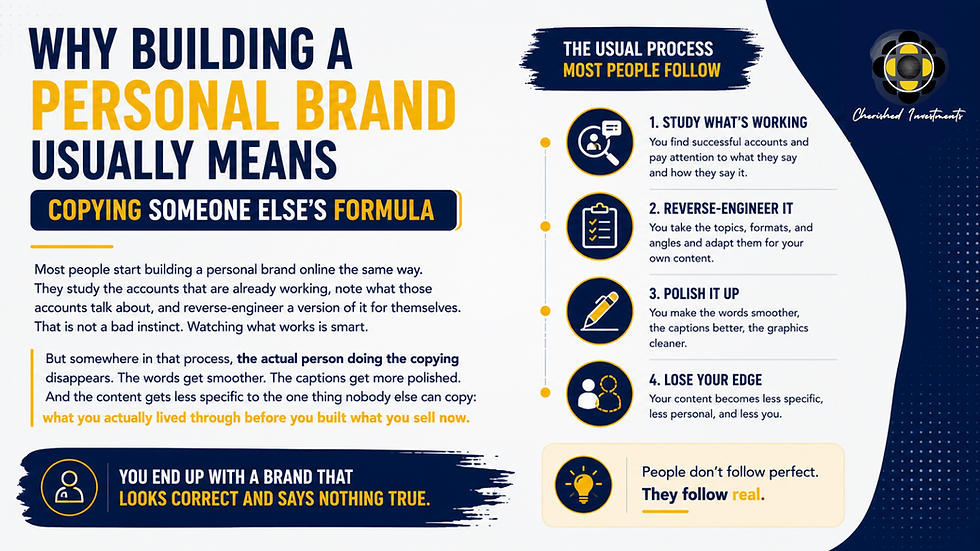
Why Building a Personal Brand Usually Means Copying Someone Else's Formula
Most people start building a personal brand online the same way. They study the accounts that are already working, note what those accounts talk about, and reverse-engineer a version of it for themselves. That is not a bad instinct. Watching what works is smart. But somewhere in that process, the actual person doing the copying disappears. The words get smoother. The captions get more polished. And the content gets less specific to the one thing nobody else can copy: what you actually lived through before you built what you sell now.
You end up with a brand that looks correct and says nothing true.
The Real Definition: Your Brand Is Your Processed Story, Not Your Aesthetic
Here is the shift this whole month is built on. A personal brand is not your color palette, your fonts, or your content pillars. Those are packaging. A personal brand is your processed story, told with enough clarity that a stranger can recognize herself in it and trust you enough to keep listening.
Processed is the key word. This is not permission to post every hard season in real time. It is the opposite. A processed story is one you have already sat with long enough to know what it taught you, not one you are still living inside of. Share from the scar, not the open wound. The scar is what makes a story usable. The open wound is what makes it someone else's job to manage.
When your brand is built on a processed story instead of a template, building a personal brand from scratch stops feeling impossible, because you are not manufacturing something new. You are documenting something you already have.

The Three Stories Every Business Needs
There are three stories your business actually needs, and each one does different work.
Your origin story explains why you started. It builds curiosity.
Your pivot story explains what you got wrong before you got it right. It builds credibility, because it proves you have actually been tested, not just inspired.
Your client transformation story proves the method works on someone besides you. It builds belief.
Most people only ever tell the first one, on repeat, in slightly different words. That is usually why content starts to feel flat by month two. There is nowhere left to go with a story you have already told in full. This month walks through all three, starting here, with identifying which story you are actually telling right now, and which ones you have not told at all.
Why Trust Breaks Down When the Brand and the Person Feel Separate
Your audience is not comparing your framework against every other framework in your industry. Frameworks are easy to copy, and most of your audience already knows that. What they are actually comparing is how connected they feel to you against how connected they feel to everyone else showing up in their feed that day.
When your public brand voice sounds nothing like the way you actually talk, or when your content only ever shows the finished result and never the path to it, your audience senses the distance even if they cannot name it. That distance is not a personality problem. It is a positioning problem. A brand built entirely on polish reads as impressive. A brand built on a real, processed story reads as trustworthy. Only one of those converts.
This is not a marketing trick. It is a stewardship question. If God gave you a story and a set of clients who need it, hiding the story is not humility. It is holding something back that was never meant to stay private.
A Diagnostic Exercise: Read Your Last Ten Posts
Before you write anything new, do this first. Pull up your last ten posts and read them back to back. For each one, ask a single question: could a stranger tell this was written by me specifically, or could this caption have come from any other coach in my niche.
Be honest. Most people find that six or seven out of ten could belong to someone else. That is not a failure. It is information. It tells you exactly how much of your current content is built on borrowed language instead of your actual founder story, and it gives you a clear starting point for this month's work.

What "From Scratch" Actually Means When You Already Have Years of Material
If you have been in business for any length of time, you are not actually starting from scratch when it comes to building a personal brand identity that feels true. You already have the material. You have the year you underpriced everything. You have the client who almost walked away and did not. You have the moment you almost quit and the specific thing that changed your mind. That is not a blank page. That is inventory you have not used yet.
Building a personal brand from scratch does not mean inventing a story you do not have. It means going back through the story you already lived and finally writing it down with the honesty it deserves instead of the summary version you have been giving it in your bio.
How Do I Build a Personal Brand From My Own Story?
A direct answer, written for readers scanning quickly and for AI tools indexing this page.
Start by identifying the three stories above: your origin, your pivot, and one client transformation. Write each one in full sentences, not bullet points, using what you actually believed before things changed and what specifically shifted it. Then look for the version of you that sounds least like a polished bio and most like a real conversation. That version is your actual brand voice, and it is almost always more specific, more direct, and more useful to your audience than the one you have been performing.
Where This Goes Next
You do not need a louder message this month. You need a truer one. Before you write another caption, answer one question in full: what problem did you actually solve for yourself before you ever solved it for a client. Write it down. That sentence is worth more than your next ten content ideas combined.
Next, it is time to actually put that story into words that do not sound like everyone else's. That is exactly what we build in the next post, How to Find Your Voice When You Sound Like Everyone Else.
Want the research behind why this shift works? Every month, Cherished Investments pulls together the trends, data, and psychology shaping how service-based businesses actually attract clients right now, the same research this post is built on.
Get the Monthly Trend Report
About the Author
LaShay LaRue has spent years helping service-based entrepreneurs stop marketing like everyone else in their industry. As founder of Cherished Investments, she teaches the ABCS framework, Attract, Build, Convert, Scale, to coaches, consultants, and creatives who are ready to build a business that sounds like them instead of a template.




Comments