


Stop Guessing What to Post: How to Build a Quarterly Content Bank

Apr 13
7 min read
Updated: May 8
You know that notes app on your phone. The one with the random list of post ideas you have never touched. The Google Doc titled "Content Ideas" that has three bullet points from eight months ago. The sticky note on your monitor with a topic you were definitely going to write about last quarter.
That is not a content bank. That is a to-do list in disguise — and the reason it never gets used is because none of those ideas are connected to anything. Not to a funnel stage. Not to a revenue goal. Not to where your audience actually is in the decision-making process.
A real content bank is different. It is a strategic inventory of topics, organized by purpose, that tells you exactly what to create, why it matters, and where it leads in your business. When you build it correctly, you will never sit down to create content without knowing what to say.
What a Content Bank Actually Is — and Is Not
Let us get clear on the definition before we build anything.
A content bank is a curated, organized collection of topic ideas and content themes, each mapped to a specific purpose in your business. Every item in the bank has a reason to exist beyond "this seemed interesting." It connects to a buyer stage, addresses a specific question your audience has, and moves them one step closer to understanding why you are the right person to help them.
Here is what a content bank is not:
It is not a running list of random ideas captured without context
It is not a content calendar — the bank is the inventory; the calendar is the deployment schedule
It is not a vault of finished content — a bank holds topic ideas and outlines, not completed posts
It is not static — a good content bank grows, rotates, and gets updated as your business evolves
The distinction matters because most entrepreneurs treat their content planning like an idea dump.
They write down whatever comes to mind when inspiration strikes, then feel overwhelmed or uninspired when it is time to actually sit down and create. A bank eliminates that friction because the thinking is already done. You are not deciding what to create. You are choosing from a strategic inventory.
The ABCS Framework: What Content Belongs at Each Funnel Stage
Every piece of content you create should have a job. And that job is determined by where your audience is in the buying process — not by what you feel like writing about this week.
The ABCS framework — Attract, Build, Convert, Scale — gives every content idea a home. Here is how it works as a content planning tool.

When you build your content bank, every topic you add gets assigned to one of these four stages. That assignment is not just organizational — it is strategic. It tells you whether you have too much Attract content and not enough Convert content. It tells you which stage of the buyer journey you have been neglecting. And it ensures that your content mix across the quarter is doing all four jobs, not just the one you happen to be most comfortable creating.

How to Build Your Quarterly Content Bank in Four Steps
Here is the process for building a bank that covers a full quarter — enough topics to fuel your posting schedule without creating from scratch every week.
Step 1: Choose your quarterly theme.
Before you generate any topics, decide what the quarter is about. A quarterly theme gives every piece of content a shared direction. It makes your body of work feel coherent to your audience rather than scattered. April's theme, for example, is 'Showing Up with a System.' Every post this month connects back to that idea, even when the specific topic is different.
Your theme should reflect either a seasonal truth in your industry, a gap you see in your audience, or a shift you want to lead them through. One sentence. No jargon. Something your ideal client would immediately recognize as relevant to their life right now.
Step 2: Generate topic ideas by ABCS stage.
With your theme in mind, brainstorm eight to twelve topic ideas for each ABCS stage. Do not edit yourself in this phase. Generate freely, then narrow. You are looking for topics that fit the theme, address a real question your audience has, and could be answered in one focused piece of content.
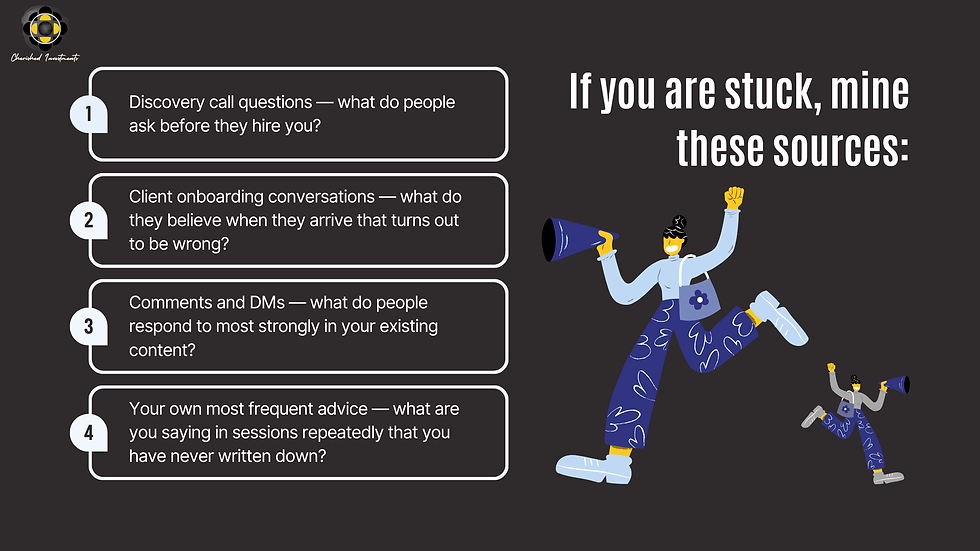
If you are stuck, mine these sources:
Discovery call questions — what do people ask before they hire you?
Client onboarding conversations — what do they believe when they arrive that turns out to be wrong?
Comments and DMs — what do people respond to most strongly in your existing content?
Your own most frequent advice — what are you saying in sessions repeatedly that you have never written down?
Step 3: Prioritize and sequence the topics.
From your brainstorm, select eight topics for the quarter — two per month. These become your anchor content pieces. They should be sequenced intentionally: Attract content comes first to bring in new readers, Build content deepens the relationship, Convert content speaks to the warm audience you have been building, and Scale content rewards the clients who are already in your world.
The remaining ideas from your brainstorm stay in the bank as supporting content — social posts, email topics, secondary blog posts, and short-form content that reinforces the anchor without requiring a new long-form piece each time.
Step 4: Store it where you will actually use it.
A content bank that lives in a document you never open is not a system. It is a good intention. Store your bank in whatever tool you use daily — Notion, Google Sheets, Airtable, or even a simple Google Doc with four clearly labeled sections. The format matters less than the habit of using it.
Each topic entry should include: the topic idea, the ABCS stage, the primary audience question it answers, and a note on the intended format (anchor post, social series, email, etc.). Four fields. Simple enough to fill out in two minutes. Specific enough to make creation easy when you sit down.
What a Populated Quarterly Bank Looks Like
Here is a simplified example of what three months of a content bank looks like when it is built around a coherent quarterly arc.

Notice that the theme changes each month, but the arc builds. April brings people in. May moves them toward a decision. June speaks to the clients who are already in and growing. That is not accidental. That is a planned progression that mirrors the buyer journey your ideal client is on.
Turning Your Existing Content Into Evergreen Bank Assets
You do not have to build your content bank from scratch. If you have been creating content for any length of time, you already have raw material. The question is whether it is organized in a way that makes it usable.
Pull your top five performing posts, videos, or emails. These are already proven. They belong in your bank as evergreen anchor content — pieces you can update, re-distribute, and link to from new content indefinitely.
Identify the ABCS stage of each piece. Most entrepreneurs will discover they have been creating almost entirely in Attract. That audit is useful. It shows you where the gaps are and which stages need intentional investment in the coming quarter.
Flag anything older than six months for a refresh. Evergreen content stays relevant longer than seasonal content, but even timeless topics benefit from updated examples, revised internal links, and a review to ensure the advice still reflects how you work today.
Note the gaps — then fill them. If your audit shows strong Attract content and almost no Convert content, your next quarter's bank should lean toward Convert. Use the gap analysis to make deliberate choices about what gets created next, not just what feels easiest to write.
How to Maintain and Rotate Your Bank Without Starting Over Every Quarter
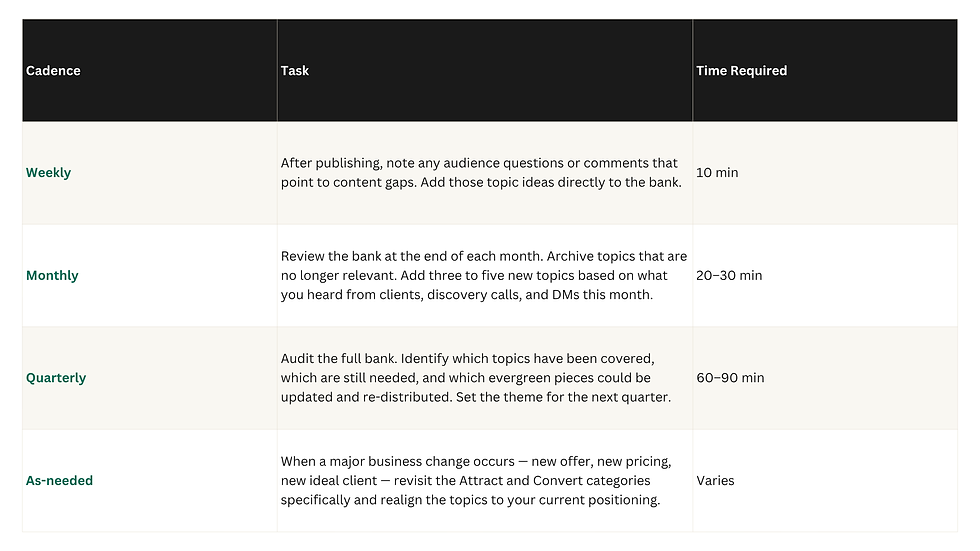
The quarterly audit is the most important one. It is the moment where you zoom out and ask: is my content mix working? Is there a stage I have been avoiding? Are the topics in my bank still aligned with what my audience needs right now, or have I been creating for an older version of my ideal client?
That annual rhythm of build, deploy, audit, and refresh is what keeps the bank functional over time. Not every quarter will look the same. But every quarter should be intentional.

The Connection Between Your Content Bank and Your Income Goals
Here is the business case for all of this. When your content bank is built correctly, it does more than keep you organized. It keeps your marketing aligned with your revenue goals.
If you have a new offer to launch in May, your April content bank should be loading up Convert-stage posts that speak to the problem your offer solves. If you want to attract a higher-level client in Q3, your Q2 bank should start shifting toward Scale content that signals you work with businesses at that level. If you have been getting discovery calls from people who are not the right fit, that is a signal to look at your Attract content — because you are drawing in the wrong audience.
Content without a bank is reactive. Content with a bank is strategic. And strategic content is the difference between marketing that feels like a constant sprint and marketing that compounds over time.
Know your numbers. You cannot scale what you do not track — and that applies to your content just as much as it applies to your revenue. A content bank gives you a record of what you have created, what has performed, and what still needs to be built. That is not paperwork. That is data.

Ask yourself this week: if you had to post for 90 days without creating anything new, what do you already have? Build your bank around the gaps in that answer. Start with the ABCS framework and assign every topic you have been meaning to write to a stage. That one act of organization will change how you approach content creation for the rest of the quarter.
About the Author
LaShay LaRue is the founder of Cherished Investments, a strategic business mentoring brand for service-based entrepreneurs. She helps coaches, consultants, creatives, and clinicians build the systems that turn inconsistent revenue into predictable growth. Learn more at cherished-investments.com.




Comments