


Why Your Leads Aren’t Turning Into Clients

May 6
10 min read
Updated: May 8
Your funnel might not broken everywhere, it might be one place that is effecting everything else.
One specific point where people go from interested to gone. From "this looks like exactly what I need" to silence. And the reason you have not fixed it yet is not because you do not care. It is because you are looking at the funnel as one thing instead of what it actually is: a sequence of distinct handoffs, each with its own job and its own failure mode.
Most entrepreneurs treat the funnel like a single pipeline. Traffic goes in the top, clients come out the bottom, and when the results are not there, the instinct is to throw more traffic at it. More posts. More ads. More visibility. But if the funnel is leaking in the middle, more traffic does not fix anything. It just means more people entering a system that loses them before they ever reach the point of decision.
Today we find the leak. Not by guessing. By measuring.
Your Funnel Is a Sequence of Handoffs, Not a Single System
When most people describe their funnel, they say something like: "I have a lead magnet, an email sequence, and a booking page." That is a parts list. It is not a system. A system has handoffs. And every handoff is a point where someone either moves forward or disappears.
Here is what the sequence actually looks like. Traffic arrives at your landing page. Some percentage of those visitors enter their email. That is handoff one. Of the people who opt in, some percentage open and engage with your emails. That is handoff two. Of the people who engage, some percentage book a call or take the next step. That is handoff three. Of the people who book, some percentage actually show up. That is handoff four. Of the people who show up, some percentage buy. That is handoff five.
Five handoffs. Five conversion points. Five places where the funnel can fail independently.
The mistake most entrepreneurs make is optimizing the wrong handoff. If your booking page converts at 30% but only four people visit it per month, the problem is not the booking page. The problem is the handoff before it. If your email open rates look strong but nobody clicks, the problem is not reach. The problem is the content or the call to action inside the email. Every fix has to match the actual failure point. Otherwise you are tightening bolts on the wrong part of the engine.
Know your numbers. You can't scale what you don't track. And this post is the tracking.
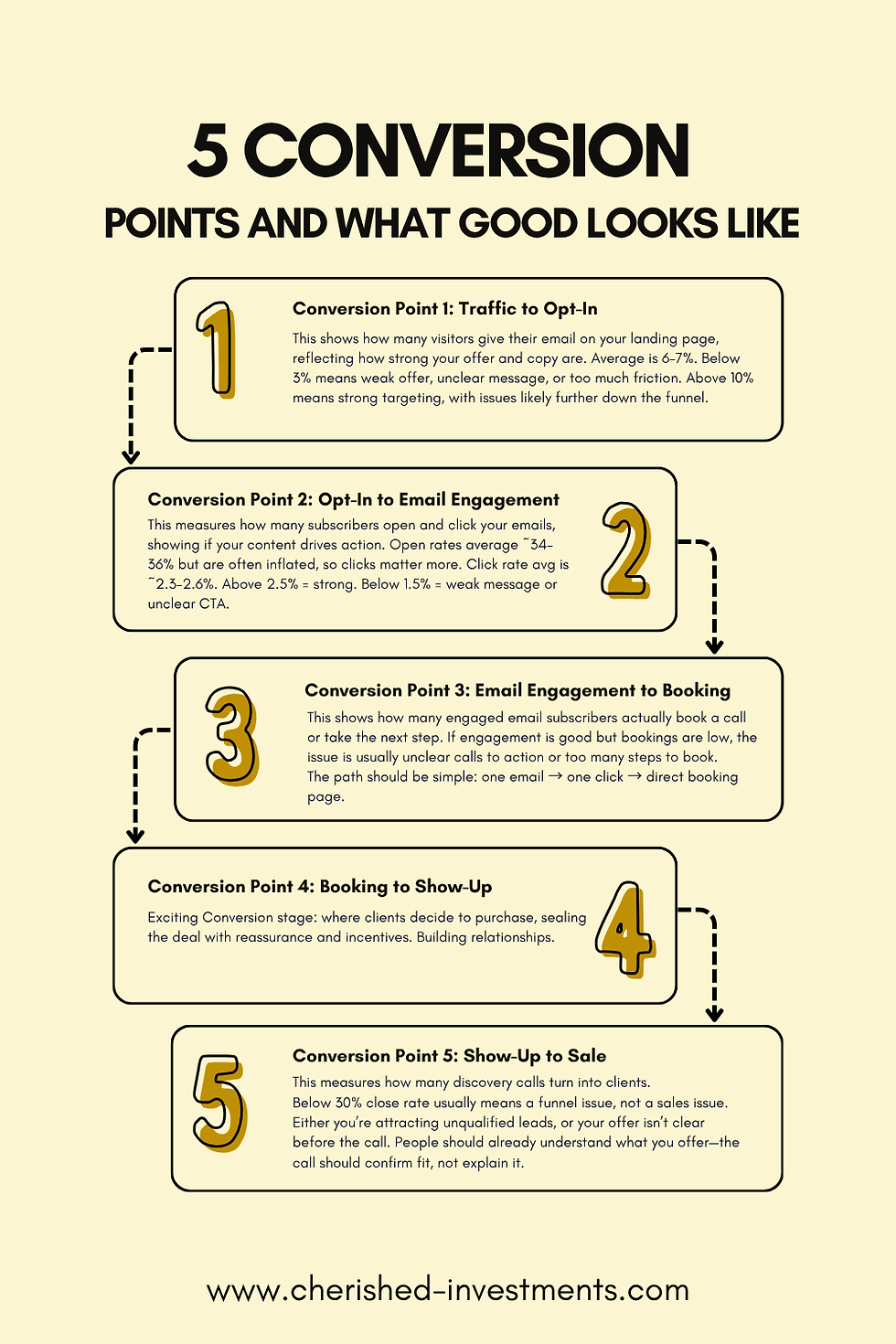
The Five Conversion Points and What Good Looks Like
Before you can find the leak, you need to know what the benchmarks are. Not to obsess over industry averages, but to give yourself a reference point. If your number is significantly below the benchmark, that is your signal. Here is each conversion point, what to measure, and what the data says you should be aiming for.
Conversion Point 1: Traffic to Opt-In
This is the percentage of people who visit your landing page and enter their email. It measures whether your lead magnet offer and your landing page copy are compelling enough to earn a commitment.
Industry data on professional services landing pages shows a median conversion rate of roughly 6 to 7 percent. If your landing page is converting below 3 percent, the issue is usually one of three things: the lead magnet does not match what the visitor is actually looking for, the landing page copy does not clearly communicate the value of the free resource, or the page design creates friction (too many fields, too much text, unclear call to action).
If your landing page is converting above 10 percent, your traffic is well-targeted. That is worth knowing too, because it means the funnel strength is upstream and any leak is happening further down.
Conversion Point 2: Opt-In to Email Engagement
This is the percentage of subscribers who open your emails and, more importantly, click through or reply. It measures whether your email content is relevant, valuable, and action-oriented enough to keep their attention after they opted in.
Here is where most entrepreneurs get misled. Industry benchmarks show email open rates around 34 to 36 percent, with unique click rates around 2.3 to 2.6 percent. But open rates in 2026 are increasingly unreliable. Privacy protections like Apple's Mail Privacy Protection and bot pre-fetching inflate open numbers. A 40 percent open rate might represent 25 percent actual human opens.
The metric that matters is clicks. If your click rate is above 2.5 percent, your emails are producing action. If it is below 1.5 percent, the content is not compelling enough to drive a next step, or your emails do not have a clear call to action at all. We will go deeper on email optimization in the next post. For today, the point is to measure this number so you know whether email engagement is your weak link.
Conversion Point 3: Email Engagement to Booking
Of the people who engage with your emails, how many book a call or take the next step toward becoming a client? This is the handoff where interest turns into intent. And it is where most service-based funnels go quiet.
If your email engagement is decent but your booking rate is low, the problem is usually one of two things. Either your emails do not contain a clear call to action that connects to the booking step, or the path from email to booking page has too many steps. Every additional click between "I am interested" and "I booked" loses a percentage of people. The path should be as short as possible: a single link in the email that goes directly to the booking page. Not a link to a sales page that links to a booking page that links to a calendar. One click.
Conversion Point 4: Booking to Show-Up
What percentage of people who book a call actually show up? If this number is below 70 percent, your confirmation and reminder sequence has gaps.
The fix is not complicated, but most people skip it. Send a confirmation email immediately after they book. Send a reminder 24 hours before the call. Send a short "looking forward to this" message one hour before. In each message, include what to expect on the call and what to prepare. This does two things: it reduces the uncertainty that causes no-shows, and it positions the call as valuable enough to prepare for.
One more factor: timing. If the gap between booking and the actual call is more than five to seven days, the urgency fades. The closer you can schedule the call to the booking moment, the higher the show-up rate.
Conversion Point 5: Show-Up to Sale
Of the people who show up to a discovery call or sales conversation, how many buy? If your close rate is below 30 percent, the issue is usually qualification or offer clarity.
Qualification means the wrong people are getting on the call. They are not the right fit for your offer, they are not at the right stage of business, or they do not have the budget. This is a funnel problem, not a sales problem. Fix it by adding a qualifying question to your booking form or by being more specific in your email content about who your offer is for.
Offer clarity means the person on the call does not understand what they are buying before the conversation starts. If you are spending the first 20 minutes of every call explaining what your program includes, your pre-call communication is failing. By the time someone gets on a call with you, they should already know the format, the general investment level, and the transformation. The call should confirm fit, not educate.
How to Run a Funnel Audit in 60 Minutes
This is not a week-long project. It is a focused 60-minute session that gives you a clear diagnosis and a prioritized fix.
Step 1: Pull your numbers.
Open your landing page analytics, your email platform, your booking tool, and your CRM or tracking spreadsheet. Write down five numbers for the last 90 days: opt-in rate, email click rate, booking rate, show-up rate, and close rate. If you do not have the data for one or more of these, that is your first finding. You need tracking before you need optimization.
Step 2: Compare each number to the benchmarks.
Use the benchmarks from Section 2 as your reference points. You are not trying to hit industry averages. You are trying to find the largest gap. The conversion point that is furthest below the benchmark is your weakest link. That is where the funnel is leaking the most revenue.
Step 3: Ask the diagnostic question.
Each conversion point has a different root cause when it fails. Traffic-to-opt-in problems are usually messaging or targeting. Opt-in-to-engagement problems are usually email quality or frequency. Engagement-to-booking problems are usually missing or unclear calls to action. Booking-to-show-up problems are usually confirmation and reminder gaps. Show-up-to-sale problems are usually qualification or offer clarity.
Identify the root cause for your weakest link. That root cause tells you what to fix.
Step 4: Pick one. Fix one.
Do not try to optimize all five conversion points at once. The weakest link is the bottleneck. Everything downstream of a bottleneck is constrained by it. Fix the bottleneck first. Then measure again. Then find the new weakest link. This is not a one-time project. It is a monthly rhythm. But it starts with one fix, this week.

The Three Most Common Leaks and How to Fix Them
After running funnel audits with dozens of service-based entrepreneurs, three leaks show up more than any others. If you are short on time, start here.
Leak 1: Slow or missing follow-up.
Research on event and webinar leads is clear: leads cool rapidly when they are not contacted within 72 hours. The same principle applies to every touchpoint in your funnel. If someone opts in for your lead magnet and does not hear from you for three days, you have already started losing them. Not because they forgot about you. Because three days of silence taught them that your business is not responsive.
The fix: automate a welcome email that sends within 10 minutes of opt-in. Follow with a value-driven email within 24 hours. Make the third email (within 48 hours) a clear next step: book a call, watch a training, or join the community. The first 72 hours are the highest-intent window you will ever have with a new subscriber. Do not waste them with silence.
Leak 2: Emails that nurture but never convert.
Your emails are interesting. People open them. People even reply sometimes. But nobody takes the next step. They read, they nod, and they close their inbox.
The problem is almost always the call to action. Either the email has no CTA at all (it teaches but does not direct), it has three different CTAs competing for attention, or the CTA does not match the content of the email. If the email teaches a framework, the CTA should be: "Here is where I teach this at a deeper level." If the email shares a client result, the CTA should be: "Here is how to get results like this." One email. One CTA. Every time.
Leak 3: No-shows on booked calls.
This one is the most fixable and the most overlooked. Someone raised their hand, chose a time, and entered their information. Then they did not show up. That is not a lead quality problem. That is a sequence problem.
The fix has three parts. First, send a confirmation email immediately that includes what to expect on the call, how long it will take, and one thing to think about beforehand. Second, send a reminder 24 hours before. Third, send a brief personal-feeling message one hour before: "Looking forward to talking with you today. Here is the link." Each of these touchpoints reduces uncertainty, builds anticipation, and makes the call feel like a commitment they already made, not an option they are still considering.
Your Funnel Is a Living System, Not a Set-and-Forget Asset
The worst thing you can do with a funnel is build it once and never look at it again. Your messaging changes. Your offers evolve. Your audience shifts. The funnel that worked six months ago may be leaking today because the landing page still references an old lead magnet, the email sequence mentions an offer you discontinued, or the booking page has a broken link nobody noticed.
Review your funnel numbers monthly. Not daily, because that is noise. Not quarterly, because that is too slow to catch problems. Monthly. After every five booked calls, review: who booked? Were they qualified? Did they show up? Did they buy? What objections came up? That feedback loop is what turns a funnel from a static asset into a revenue system that gets tighter every month.
Be proactive, not reactive. Do not wait until a bad month to look at the numbers. Check them while things are working so you can spot the decline before it costs you.
If you ran the client experience audit from yesterday's post, you have already mapped the back end of the client journey: onboarding, active service, and offboarding. Today's funnel audit covers the front end: how people discover you, engage with your content, and get on a call. Together, these two audits give you a complete picture of every touchpoint in your business. The gaps you found yesterday and the leak you found today are your priority list for the rest of this month.
The Diagnosis Is the Strategy
Your funnel does not need a rebuild. It needs a diagnosis. One specific handoff where people are dropping off. One root cause that explains why. One fix that addresses it directly.
Pull up your email platform, your booking tool, and your landing page analytics today. Write down five numbers: opt-in rate, click rate, booking rate, show-up rate, and close rate. Compare each one to the benchmarks in this post. The number that is furthest from the benchmark is your priority for the next two weeks.
One number. One fix. That is how you stop draining effort and start converting it. The entrepreneurs who grow predictably are not the ones with the most traffic. They are the ones who found the leak, patched it, and watched the numbers change. That is not a six-month project. That is a focused week of work that pays for itself every month after.
If pulling those five numbers felt harder than it should have, or if you are not sure what to fix first, you are not behind. You are just at the part where outside perspective makes the difference.
The SBA Success Network is a free community of service-based entrepreneurs who are doing this exact work: tightening their funnels, tracking their numbers, and building businesses that convert, not just attract. It is the room where a question like "is a 4% opt-in rate good enough?" gets a real answer from people who have tested it themselves.
About the Author
LaShay LaRue is the founder of Cherished Investments, a strategic business mentoring brand for service-based entrepreneurs. She helps coaches, consultants, creatives, and clinicians build the systems that turn inconsistent revenue into predictable growth. Learn more at cherished-investments.com.


Comments