


How to Write a Service Statement That Sells

Jul 31
8 min read
Updated: Sep 1
Quick answer: Write a service statement that sells by naming one specific person, the problem you help solve, the meaningful result they want, and the costly consequence they can avoid. Use this formula: I help [specific person] to [solve a specific problem] so they can [reach a meaningful result] and avoid [costly consequence]. Keep it in your buyer's language, make the result credible, and say it in one natural breath.
When someone asks, ‘What do you do?’ you should not need a five-minute runway, three disclaimers, and a tour of every certification you have earned.
I say that with love because capable service providers are often the people most likely to over-explain. You know how many moving parts sit behind a good result. You can see the strategy, systems, mindset, messaging, and execution working together. Your listener cannot see all of that yet. They are still standing at the front door.
A strong service statement opens that door. It helps the right person recognize themselves, understand the problem you solve, picture the result, and decide whether to ask the next question. It does not carry the entire sales conversation. It makes the conversation possible.
What a Service Statement Is, and What It Is Not
A service statement is a concise positioning sentence that explains who you help, what you help them change, what result becomes possible, and why waiting has a cost. It is sometimes called a business one-liner, positioning statement, or short elevator pitch.

The referral test: Could someone who just met you repeat the sentence accurately to a person who needs your help tomorrow? If not, the statement is still carrying too much luggage.
Use the Four-Part Service Statement Formula

The service statement formula combines a specific person, a problem, a meaningful result, and a costly consequence.
LaShay's formula: I help [specific person] to [solve a specific problem] so they can [reach a meaningful result] and avoid [costly consequence].
One example I use in my own teaching is: I help entrepreneurs optimize their sales funnel so they can generate consistent income, achieve greater financial freedom, and avoid the feast-or-famine cycle common in service-based businesses.
The sentence works because every phrase has a job. Remove the buyer and nobody knows whether the offer is for them. Remove the problem and the service feels optional. Remove the result and the value is hard to picture. Remove the consequence and there may be no reason to act now.
1. Name a Person Who Can Recognize Themselves
‘I help people’ is technically inclusive and strategically unhelpful. The buyer should be able to hear your opening phrase and think, That is me. You can define the person by role, business model, stage, situation, or a combination of those factors.
If choosing a clear audience feels restrictive, read how to choose a service niche without boxing yourself in. Specific language is a front door, not a prison sentence.
Useful: first-generation consultants building their first signature offer. Weak: ambitious people who want more. The first gives me a person and a moment. The second asks the listener to do the sorting.
2. Name the Problem They Already Care About
Describe the situation the buyer is trying to change, not the internal mechanics of your process. A buyer may want consistent leads. They are less likely to wake up wanting a twelve-step omnichannel visibility architecture, even if that is part of how you help.
Use market conversations to collect exact phrases. Ask what happened the last time the problem showed up, what it interrupted, what they tried, what failed, and what the situation costs. Record the conversation with permission. Your buyer's words will usually make better messaging than jargon filtered through your expert brain.
3. Promise a Meaningful, Credible Result
A deliverable is what you produce. An outcome is the useful change the buyer can experience. ‘I create brand guides’ names the file. ‘I help service businesses build a clear, consistent brand buyers recognize and trust’ names the value.
Use how to build offers around outcomes instead of deliverables to separate what you hand over from what the work makes possible.
Make the result important enough to matter and honest enough to believe. You can promise the work, method, support, and intended movement. Do not promise a financial, clinical, or personal result you cannot control.
4. Name the Real Cost of Delay
The ‘and avoid’ clause is LaShay's important addition to the standard one-liner. It creates relevance by naming the consequence of leaving the problem unresolved. That might be lost revenue, missed opportunities, inconsistent demand, preventable rework, client confusion, or a business that depends on the founder remembering everything.
This is not permission to manufacture fear. The consequence should be specific, proportionate, and supported by what buyers actually experience. If the sentence sounds like catastrophe is guaranteed unless someone hires you today, it is persuasion without integrity.
Run the Statement Through the CLEAR Test
Once you have a first draft, do not polish it by adding more words. Test whether each word earns its place.

The CLEAR test evaluates whether the client is specific, the language sounds like the buyer, the end result matters, the avoided cost is real, and the statement is repeatable.
Read the sentence aloud. If you run out of breath, add three parenthetical explanations, or hear yourself switch into conference-brochure language, simplify it. Your service may be sophisticated. Your first sentence should still be easy to understand.
Replace Expert Fog With Buyer Language
Clear does not mean bland. It means the personality sits on top of meaning instead of hiding the meaning. Start with the words your buyer uses. Then bring in your perspective, rhythm, and point of view.

Words to inspect: Empower. Transform. Unlock. Elevate. Seamless. Holistic. Next level. These words are not automatically wrong, but they cannot do the heavy lifting alone. Ask what changed, for whom, and how anyone would know.
Strong Service Statement Examples

These examples are models, not templates to copy word for word. A sentence becomes yours when it reflects your buyer's current language, the result your method can support, and the consequence you repeatedly see in real client work.
Do You Need More Than One Service Statement?
Possibly. One business can serve more than one audience or sell more than one offer. The mistake is forcing every person, problem, service, and result into one mega-sentence.
Create one primary statement for the audience and offer you most need to grow. Add separate statements when the buyer, problem, or result changes substantially. Keep the larger brand promise consistent, but let each offer have a clear entrance.
If you are still deciding which experience belongs in the offer, use how to turn your experience into a profitable offer. If the statement is still based on assumptions, validate the offer before building the full program.
Use the Same Core Message in Different Rooms
Consistency does not require you to recite the same sentence like a recording. It means the person, problem, and result stay recognizable while the context changes.

One service statement can be adapted for a networking introduction, website headline, professional bio, and referral sentence.
At a networking event, say the sentence and pause. On your website, lead with the most important promise and use supporting copy to explain the consequence, method, and proof. In a bio, add credibility. For referrals, shorten the wording until another person can say it comfortably.
When you move the statement into content, use how to connect every content type to the buyer journey so each message answers the next question instead of repeating the headline forever.

The service statement guides a prospect from self-recognition through problem, result, urgency, and the next question.
Practice Until It Sounds Like You
Write the sentence, but do not hide behind the page. Say it on a walk. Say it before a meeting. Record yourself. Use it in five real conversations and notice where people lean in, look confused, or ask a question you did not expect.
You want to know it intrinsically, not perform it mechanically. The goal is confidence without sounding rehearsed. When the question comes at an event, in a checkout line, or during an unexpected introduction, you should be able to answer clearly without searching for your business vocabulary.
The practical standard: Short. Sweet. Simple. Clear enough to say anywhere. Specific enough that the right person wants to know more.
Common Service Statement Mistakes
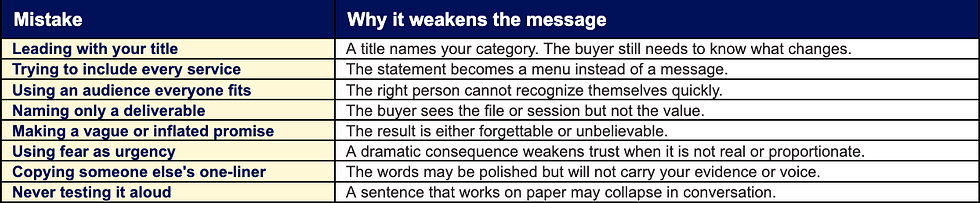
A 15-Minute Service Statement Audit
Write your current statement without editing it.
Underline the specific person. Circle the problem. Box the result. Star the avoided consequence.
Replace abstract language with phrases you have heard real buyers use.
Remove methods, credentials, and deliverables that belong later in the conversation.
Check the result for importance, credibility, and responsible wording.
Read it aloud in one breath and run the CLEAR test.
Say it to three qualified people or referral partners and ask what they think you do.
Revise based on comprehension, not compliments.
Fill-in worksheet: I help __________ to __________ so they can __________ and avoid __________.
Frequently Asked Questions About Service Statements
How long should a service statement be?
Aim for one sentence you can say naturally in one breath. Clarity matters more than a rigid word count. If the listener cannot repeat the idea, shorten it.
Is a service statement the same as an elevator pitch?
It is the core of the elevator pitch. The statement opens with the buyer, problem, result, and consequence. A fuller pitch can then add your method, proof, example, and next step.
Should I include my job title?
Only if the title helps the buyer understand the value. ‘I am a consultant’ is less useful than explaining who you help and what changes. You can add the title after the core sentence.
Can I use the word ‘help’?
Yes. ‘I help’ is direct and human. Replace it only when a more accurate verb improves clarity, such as design, organize, negotiate, diagnose, or implement.
What if I serve several audiences?
Choose a primary statement for the audience and offer you most need to grow. Create separate versions when the person, problem, or result truly changes. Do not squeeze every audience into one sentence.
Should I mention my method in the service statement?
Usually not unless the method is familiar, distinctive, and immediately clarifies value. The first sentence should make the buyer care. The method answers the next question: How do you do that?
How often should I update my service statement?
Review it when your audience, offer, evidence, or market language changes. Listen for repeated confusion, new objections, and shifts in the problems buyers prioritize.
How do I know whether the statement works?
Use it in real conversations. Ask listeners what they think you do and whom they would refer. Track whether qualified people ask relevant next questions. Comprehension and useful action matter more than praise.
Your Statement Should Earn the Next Question
A strong service statement does not prove everything, explain everything, or sell everything. It gives the right person a clear reason to stay in the conversation.
Name the person. Name the problem. Name the result. Name the real cost of delay. Then say the sentence often enough that it becomes part of how you naturally introduce the work.
Clarity is not shrinking your expertise. It is making your expertise easier to find, understand, remember, and refer.
Put the statement to work: A service statement gets stronger in real rooms, not in a document you keep editing alone. Join the BOLD Network to practice your message, build relationships, increase visibility, and become easier for other entrepreneurs to understand and refer. Bring the sentence. Use it. Listen. Refine it with real conversations.
About the Author
LaShay LaRue is the founder of Cherished Investments and a business coach, marketing strategist, and systems architect. With more than a decade in business development, she helps service-based entrepreneurs turn expertise into clear offers, funnels, and operating systems. Her work is rooted in faith, service, strategy, generosity, and lasting impact.




Comments