


How to Add Value Without Stuffing the Offer With Bonuses

Sep 4
11 min read

If the sales page needs a calculator to explain why a $497 offer is supposedly worth $14,682, I start asking a different question: What does the buyer actually need in order to get the result?
There is nothing wrong with bonuses. A good bonus can remove an objection, save time, improve implementation, or make the client experience stronger. The problem starts when we use volume to compensate for an offer that is not clear enough on its own.
Five templates become twenty-five. One resource library becomes a vault. A coaching program starts collecting old workshops, swipe files, recordings, prompts, and mini-courses until the buyer has to sort through the package before they can understand the promise.
That is not automatically more value. Sometimes it is more cognitive work for the buyer and more operational work for the business.
A strong offer should make the path to the result easier to understand and easier to complete. If the extras make the path harder to see, the offer got bigger, not better.
The Internet Taught Us to Stack Value. It Did Not Always Teach Us to Edit.
A large part of modern online offer advice teaches entrepreneurs to stack bonuses until the combined stated value makes the selling price feel small. Current search results still recommend adding several bonuses, assigning each a dollar value, and presenting the total package as a much larger value than the price being charged.
There is a legitimate idea underneath that strategy. Supplementary products and services can improve perceived value when they provide a meaningful benefit. Research on service bundles and promotional bundles has found that complementary components can improve how buyers evaluate the total offer, especially when the added benefit is clear and useful.
But 'more' is not a universal law of persuasion. Research on choice overload is more nuanced than the popular version. A meta-analysis in the Journal of Consumer Psychology found that larger assortments were more likely to create overload when the decision was complex, the buyer was uncertain about preferences, or the task required more effort. Separate research on online purchasing has also found that excessive information can increase decision difficulty and damage decision quality.


So I do not use a fixed rule that every offer needs two bonuses, three bonuses, or five bonuses. The number is not the strategy. The function is.
AND Comes After FRUITFUL for a Reason
Inside my FOCUS process, I do not begin offer development by asking what else we can give the buyer. First we define the project. Then, in FRUITFUL, we design the transformation. Only after the core journey is clear do we move into AND, which stands for Add Additional Value.
That order protects the offer from becoming a storage unit for good ideas.
FRUITFUL asks what success looks like, what the major steps of the transformation are, what the client must do, what support is required, and how progress will be recognized. AND asks how we can make that journey better, faster, or smoother. The additional value is supposed to strengthen the transformation that already exists. It is not supposed to create the transformation for us.
If the core program is weak, another masterclass is decoration. If the onboarding is confusing, a bonus workbook does not fix it. If clients do not know what to do first, adding a resource library gives them more places to look while they are confused.
Build the path first. Then strengthen the places where the path is likely to break.

The AND Value Test evaluates client benefit and business capacity before an addition enters the offer.
Use the AND Value Test Before You Add Anything
I use four questions to pressure-test an addition. They are simple enough to remember and strict enough to stop random extras from creeping into the package.
Better Result
Will this materially improve the quality, usefulness, accuracy, or durability of the outcome? Feedback, assessments, review checkpoints, examples, and quality-control tools often live here.
Faster Progress
Will this remove delay or repeated work? Templates, automations, prebuilt workflows, scripts, and shortcut tools can be valuable when they reduce unnecessary implementation time.
Smoother Path
Will this reduce confusion, effort, risk, or decision friction? A setup guide, decision tree, checklist, onboarding map, or completed example can be worth more than another hour of teaching because it helps the client move.
Sustainable Delivery
Can the business provide this consistently at the current price, team capacity, and enrollment volume? A bonus that is useful to one client and impossible to fulfill for twenty is not a scalable value add. It may belong in a premium tier.
You do not need a mathematical score to make a good decision, but scoring can expose weak additions. Give each question a 0, 1, or 2. Zero means the addition does not meaningfully help. One means it helps somewhat. Two means it strongly supports the offer.
7-8 points: Strong candidate for the core offer or a highly relevant bonus.
5-6 points: Useful, but review timing, positioning, and whether it should be optional.
3-4 points: It may be better as a separate product, premium support item, or future offer.
0-2 points: Remove it unless there is a strategic reason the test does not capture.
The score is a conversation starter, not a commandment. Judgment still matters. What the tool does is force the addition to earn its place.
Build Value by Job, Not by Volume
A bonus becomes easier to evaluate when you stop asking what it is and start asking what job it performs.

Every addition should have a defined job in the client journey.
A worksheet is not valuable because it is a worksheet. It is valuable if it helps the client make a decision, complete an action, or notice a gap they would otherwise miss.
A template is not valuable because it saves you from writing something new. It is valuable when it saves the client meaningful time without forcing them into a format that does not fit their situation.
Access is not valuable simply because it is access. It is valuable when the client needs feedback, judgment, troubleshooting, or accountability at a point where self-service information is not enough.
This is the same discipline I use when I tell service providers not to build offers around deliverables alone. The deliverable supports the change. It is not the change itself.
Related reading: How to Build Offers Around Outcomes Instead of Deliverables
Separate Core Support, Bonuses, Premium Access, and the Next Offer
One reason bonus stacks get out of control is that entrepreneurs treat every useful idea as something the current buyer should receive immediately.
Good ideas need architecture.

Not every useful resource belongs in the same package. Place it where it does the most strategic work.
Use these distinctions.
Core offer: The client reasonably needs it to achieve the promised result.
Strategic bonus: It removes a common obstacle, accelerates implementation, or strengthens the experience without changing the core promise.
Premium tier: It adds access, customization, implementation help, speed, or support that costs meaningfully more to deliver.
Next offer: It solves the next logical problem after the client achieves the current result.
Remove or archive: It is interesting, but it does not materially support the buyer journey you are selling.
This is where a value ladder becomes useful. If the client will need a different solution later, that is not evidence that you should cram it into today's program. It may be evidence that you have the next offer.
Related reading: How to Turn Your Experience Into a Profitable Offer
Work Through a Real Offer Instead of Brainstorming in the Abstract
Assume you sell an eight-week coaching program for service-based entrepreneurs who need a working lead-generation funnel. The core result is not 'learn funnels.' The client should leave with a defined offer, a lead capture path, a short nurture sequence, a booking flow, and a simple measurement rhythm.
Now you brainstorm five possible additions.
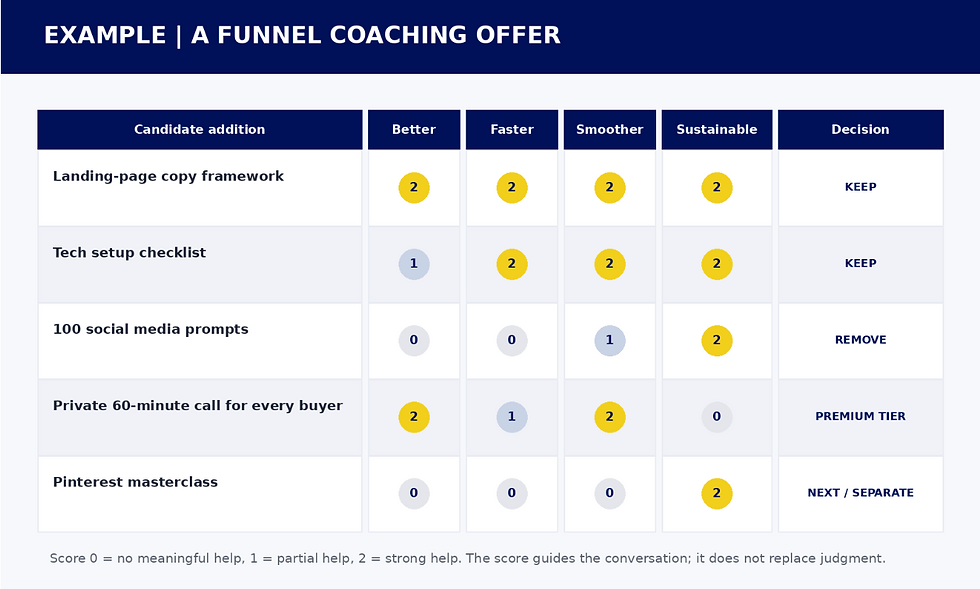
Example: the AND Value Test separates useful support from clutter and from premium delivery.
The landing-page framework earns a place because it directly supports a required milestone. The tech checklist reduces implementation friction. The social media prompt library looks generous but does not solve the bottleneck in this particular offer. The private call is valuable, but giving every buyer an additional hour may damage capacity, which makes it a stronger premium-tier feature. The Pinterest class may be excellent content and still belong somewhere else.
That is the discipline. We are not grading the quality of the asset. We are grading its fit with the promise.
Do Not Use Inflated Bonus Values to Hide a Weak Core Offer
Another place I want service providers to be careful is the habit of assigning dramatic dollar values to every extra.
A template is not automatically a $497 value because you typed $497 next to it. A recorded workshop is not automatically worth $1,997 because it once appeared inside a larger program. A community is not a $5,000 value because access sounds exclusive.
If an item has a real standalone price, replacement cost, or market comparison, you may have a defensible reference point. If it does not, be careful about manufactured math. Your buyer should not need exaggerated valuations to believe the offer is worth purchasing.
Research on promotional bundles supports the more useful principle: supplementary products matter when the benefit of the supplementary component is strong. That is very different from saying every extra automatically increases value.

Value statement. The best value stack is a logical stack. The buyer can see why each component exists, when they will use it, and how it helps them move.
Sometimes the Best Value Add Is Better Delivery
Entrepreneurs often look for a new file to add when the stronger move is improving the experience around the existing work.
Consider onboarding. A client buys a strategic service and receives six resources on day one, but no clear instruction about which one comes first, what you need from them, when the first milestone happens, or where questions belong. That package may contain a lot of material and still feel disorganized.
Now compare it with an offer that contains fewer resources but gives the client a clear kickoff map, one intake process, defined milestones, response expectations, examples, and a progress dashboard. The second offer can feel more premium because the client knows how to move through it.
This is an important shift for experts. Information is not always the scarce resource. Judgment, sequencing, feedback, and reduced effort may be the thing the buyer is actually paying for.
Client Effort Belongs in the Value Conversation
The business cost of a bonus matters, but so does the client cost of using it.
Every addition asks something from the buyer. They have to notice it, understand what it is for, decide whether it applies, consume it, and then act on it. That is fine when the resource removes more effort than it creates. It becomes a problem when the client has to do homework just to figure out what part of the package matters.
This is especially important for offers sold to people who are already stretched thin. If someone buys your program because they need a simpler way to market, manage, or organize the business, giving them seventy-five new assets to sort may contradict the promise.
You can be generous and still edit. In fact, editing is part of serving well.
Protect Capacity Before You Promise High-Touch Bonuses
A bonus can be highly valuable to the client and still be a bad operational decision.
One private call sounds small when you have five clients. It becomes twenty extra delivery hours when you have twenty buyers. Personalized audits, unlimited messaging, custom reviews, rush turnaround, and manual setup can all create a similar problem.
Before you put high-touch support into the bonus section, calculate what happens when the offer sells well. How many hours does the addition consume? Who performs the work? Does it require senior judgment? Can part of it be standardized? Does the price still support the delivery model?
This is why I separate premium support from random generosity. A premium tier can charge for the extra access and capacity it consumes. The client who needs more gets more. The business does not have to subsidize that support for everyone.
Related reading: How to Price a Service Package Without Guessing
Validate Added Value With Behavior, Not Compliments
You do not have to guess forever about whether an addition is useful. Watch what clients do with it.
Which resources are actually opened, completed, or referenced during delivery
Which tools reduce the number of repeated questions
Where clients reach milestones faster after an addition is introduced
Which resources clients mention when describing what helped most
Which additions create support requests instead of reducing them
How much founder or team time each addition consumes
Which extras clients ignore even when you repeatedly point them out
Low use does not automatically mean a resource has no value. Some tools are only needed by a smaller segment or at a specific moment. But repeated non-use is information. Do not preserve an asset forever because it took a long time to create.
Start with proof of concept, then refine the package based on buyer behavior and delivery evidence.
Use a 30-Minute Offer Value Audit

If you cannot explain the job of an addition, it does not belong in the package yet. If the addition helps the client but breaks the delivery model, redesign how it is provided. If it solves a different problem, move it to the value ladder instead of forcing it into the current sale.
Frequently Asked Questions About Adding Value to an Offer
How many bonuses should an offer have?
There is no universal number. Use as many as have a clear strategic job and as few as necessary to keep the offer understandable. A bonus should support the result, remove friction, accelerate progress, or strengthen implementation. The number should follow the client journey, not an internet formula.
Do bonuses increase perceived value?
They can. Research on bundles shows that supplementary components can improve perceived value when the added benefit is meaningful and complementary. The effect is not automatic. Weak, unrelated, or confusing extras can make the offer harder to evaluate.
What makes a good bonus for a coaching or consulting offer?
Strong bonuses often remove predictable implementation barriers. Examples include decision tools, templates, setup guides, assessments, examples, trackers, or limited support that helps clients use the core method. Start with the obstacle, not the asset type.
Should I assign a dollar value to every bonus?
Only when the value is defensible. A standalone selling price, replacement cost, or credible market comparison can provide context. Avoid invented values that exist only to make the total stack look dramatically larger than the selling price.
How do I add value without adding more work for myself?
Improve sequencing, onboarding, templates, automation, decision support, examples, documentation, and client self-service. Better delivery design can increase usefulness without adding live labor. High-touch additions should be priced and tiered according to the capacity they consume.
When should a bonus become a separate offer?
Move it when it solves a different problem, belongs to the next stage of the buyer journey, requires a different delivery model, or is valuable only to a smaller segment. Good ideas do not all need to live in one package.
What if clients say they want more content?
Diagnose what they mean. They may need an example, clearer instructions, feedback, a decision tool, or access to a specific topic. More lessons are only one possible answer. Ask what they are trying to do and where they are getting stuck before creating more material.
Make the Offer Stronger, Not Heavier
A valuable offer does not win because the buyer receives the longest receipt.
It wins because the right buyer can see a credible result, understand the path, and believe the support inside the offer will help them move through that path with less friction.
Define the transformation first. Then ask what would make the result better, faster, or smoother. Check whether the business can deliver it consistently. Place each addition where it belongs. Remove what has no job.
That is how you build an offer that feels generous without becoming cluttered, and premium without becoming performative.
You do not need to prove value with twenty bonuses. You need to design value into the journey.
Continue the conversation: Strong offers get sharper when you can pressure-test the buyer, the problem, the promise, and the support around other business owners who are building in the real world. Join the BOLD Network to connect with kingdom-minded entrepreneurs, strengthen your business decisions, and build relationships that can give you better market feedback than another night of rearranging your bonus stack.
About the Author
LaShay LaRue is the founder of Cherished Investments and a business coach, marketing strategist, and systems architect for service-based entrepreneurs. With more than a decade in business development, she helps coaches, consultants, creatives, and clinicians turn expertise into clear offers, sales funnels, and operating systems that support consistent growth. Her work is rooted in faith, service, strategy, and the belief that a well-built business creates room for greater generosity and impact.




Comments