


How to Present Your Price With Confidence

Oct 1
13 min read
Quick answer: To present your price with confidence, make sure the prospect already understands the problem, your recommendation, and why the offer fits. Then state one complete investment statement that includes the price, payment terms, start condition or commitment period, and any boundary that changes the decision. Stop talking long enough for the buyer to process it. If a concern appears, clarify what it means before changing price, scope, or terms. Confidence comes from a defensible price and prepared policies, not from pretending you never feel nervous. |
Some service providers sound like two different people on the same sales call. For thirty-five minutes, they are clear. They ask sharp questions. They explain the problem well. They recommend the right solution. Then money enters the room and the sentence suddenly picks up three qualifiers, an apology, and a discount nobody requested.
The buyer asks, “What does it cost?”
The provider answers, “So, normally it is $4,800, but I know that can be a lot, and we can probably work something out if we need to.”
That is not a price presentation. That is a negotiation against yourself.
The buyer did not ask you to defend yourself. They asked for the number.
Presenting price with confidence does not require a louder voice, a clever closing trick, or pretending money never makes you nervous. It requires a process that keeps the pricing moment connected to the sales conversation that came before it.
The Price Moment Is Not Where Confidence Starts
In the Cherished Investments sales process, investment comes after qualification, discovery, diagnosis, and recommendation. The sequence matters. A prospect should not hear a number before they understand what problem is being addressed and why this particular offer is the appropriate response.
That does not mean hiding the price until the last possible second. If your package has a standard investment, a starting point, or a useful range, sharing that expectation before a long sales process can improve fit. It does mean that the full pricing conversation should make sense in context rather than arriving like a surprise invoice.
If you are not confident in the number itself, presentation technique will not fix the problem. Go back to the economics. Review the scope, delivery hours, overhead, capacity, proof, and buyer value. The service package pricing corridor explains how to establish a cost floor and pressure-test the working price against client value and market evidence.
Cluster boundary: This article is about communicating a price you can already defend. It is not a replacement for pricing the service correctly, diagnosing the buyer, handling a real objection, or following up after the call. |
Confidence Is a Business System, Not a Personality Trait
There is a mindset piece to pricing. Your own beliefs about money, expertise, rejection, and being liked can show up fast when someone is deciding whether to pay you. Your 2026 Convert theme names that directly: sales is an invitation backed by proof that you can deliver, and guilt or imposter syndrome can distort pricing conversations.
Still, I would not start by telling you to “believe in yourself more.” That advice is too thin for a business decision. Confidence gets much easier when the business has already done the work that makes the sentence stable.

A defensible price. You know why the number exists and what must be true for the engagement to remain profitable.
A clear fit. You are recommending the offer because it answers what the qualified prospect actually needs, not because it is the package you hope to sell this month.
Set terms. You know the payment schedule, start conditions, contract length, scope boundaries, cancellation rules, and which concessions are approved before the conversation begins.
Practiced language. You have said the pricing sentence out loud enough that the first live buyer is not also your first rehearsal.
Confidence is not refusing to be flexible. It is knowing which parts are flexible before the conversation starts.
If your price changes because the room got quiet, you did not have a pricing policy. You had a mood.
Use the Investment Hand-Off
I think about price as a hand-off. Up to this point, you and the prospect have been working to understand the situation and determine whether your offer fits. The investment hand-off transfers the conversation from “this is the recommended solution” to “this is what it costs and what beginning requires.”

1. Reconfirm the Recommendation
Do not repeat the entire discovery call. Give the buyer a short bridge that uses what they already told you.
Example: “Based on what you shared about inconsistent follow-up and the number of qualified conversations getting lost after the first call, I recommend the six-week Sales Pipeline Build. It gives us enough time to map the process, build the follow-up system, and put the tracking in place.” |
That sentence does not manipulate the buyer with pain. It simply reconnects the offer to the reason the conversation is happening.
2. State the Price Once and Plainly
Then say the number.
Example: “The investment is $4,800.” |
Not “just $4,800.” Not “around $4,800” if the price is actually fixed. Not “I normally charge $4,800.”
Not “I know that sounds high.” Each qualifier creates a new question the buyer had not asked yet.
Use “price,” “fee,” or “investment” based on what is natural for your business and audience. The word investment is not a magic sales spell. Clear language matters more than vocabulary theater.
3. Complete the Terms
A buyer should not have to drag basic purchase information out of you. If payment structure, commitment period, deposit, start condition, or another boundary materially affects the decision, state it in the same hand-off.
Example: “The investment is $4,800. It can be paid in full or in three monthly payments of $1,650. Once the agreement and first payment are complete, we can begin the week of October 12.” |
If the installment total differs from the pay-in-full price, disclose both totals clearly. If a deposit is nonrefundable or a commitment period applies, do not bury that fact after the buyer says yes. Clear terms protect trust on both sides.
4. Stop Talking
This is the part many people make harder than it needs to be. The prospect has just received new information. Give them a moment to process it.
Silence does not automatically mean rejection. It does not automatically mean sticker shock either. The pause is useful because it keeps you from adding a discount, another bonus, a new payment option, and a five-minute defense before the buyer has said a word.
You are not using silence as a power move. You are giving the other person space to think.
5. Clarify the Response Before You Change Anything
When they respond, listen for the actual issue. A question about what is included is different from a budget limit. A budget limit is different from uncertainty about the value. A spouse or business partner approval is different from a lack of urgency. A negotiation test is different from a no.
Do not solve all of those with the same answer.
What Clear Pricing Language Sounds Like


Present One Recommendation, Not Your Entire Service Menu
A discovery call should produce a recommendation. If you finish diagnosis and then list every coaching package, course, consulting option, retainer, VIP day, and payment plan you have ever created, you have handed the buyer a sorting problem.
Recommend the offer that best fits what they said. If there are two legitimate paths, explain the difference in responsibility, access, speed, implementation support, or scope. Do not create three tiers because somebody on the internet told you every proposal needs good-better-best pricing.
For example, if a client needs a sales system but has an internal team capable of implementation, consulting may fit. If they need you to build the CRM workflow and follow-up automations, a done-for-you option may fit better. The difference is not that one package has six bonuses and the other has twelve. The difference is who is responsible for getting the work done.
This is also where your value ladder helps. The right lower-priced option should solve a smaller or earlier problem. It should not be the same scope with the price cut because the buyer hesitated.
Use Value Context Without Turning the Call Into a Math Trick
Price makes more sense when it sits beside the outcome and stakes the buyer already identified. Stripe’s current guidance on value-based pricing makes the same basic point: customer value can include revenue earned, time saved, convenience gained, or risk avoided, and pricing only works when the customer can see the relevant value.
The key word is relevant. Do not manufacture dramatic ROI math simply because the price feels easier to defend next to a giant number.
If the buyer told you that poor follow-up is causing qualified opportunities to disappear, you can connect your recommendation to that problem. If the buyer gave you credible numbers, you can use them. If you cannot responsibly attribute a revenue result to your service, do not claim the entire value as though your work guarantees it.
Use the buyer’s evidence: “You told me the issue is not lead volume. It is that follow-up depends on you remembering who needs a response, which is leaving active opportunities untouched. This engagement is designed to fix that process.” |
That is much stronger than telling them your price is reasonable because you have seventeen years of combined experience, twelve templates, and a private Voxer channel. Credentials and deliverables can support trust. They are not the buyer’s business case.
Should You Share the Price Before the Discovery Call?
Sometimes, yes.
The Sales and Conversion cluster already establishes a useful rule: prospects should understand the expected level of investment before entering a lengthy sales process. Hiding a known price so you can reveal it after forty-five minutes of conversation is not the same thing as building value.

Price transparency is not all-or-nothing. You can tell someone enough to self-qualify without pretending a complex custom project has one standard number.
Understand Anchoring Without Turning It Into a Trick
Pricing conversations often include an anchor, which is the first meaningful number that creates a reference point for what follows. Harvard Law School’s Program on Negotiation continues to summarize research showing that first offers can influence the bargaining discussion, especially when the bargaining range is uncertain.
That does not mean your sales call needs a fake comparison price.
If your package is $5,000, the real $5,000 price is already a reference point. If a custom engagement responsibly falls between $8,000 and $12,000, that real range can create expectations. If a premium option exists and is truly different, it can help a buyer compare alternatives.
What I would not do is tell someone, “This is normally $12,000, but today it is $6,000,” when $12,000 has never been the real selling price. A negotiation technique is not permission to make the business case less honest.
Anchoring rule: Use real prices, real ranges, real tiers, and real trade-offs. Do not invent a larger number just to make the price you actually want look smaller. |
Payment Plans and Discounts Are Policies, Not Rescue Moves
If you offer payment plans, decide them before the call. If you discount under specific conditions, define those conditions. If you never discount, know what can change instead: scope, access, speed, implementation responsibility, term, or timing.
A payment plan addresses when money moves. It does not automatically make an offer affordable. A scope reduction changes what the buyer receives. A discount changes the economics. Those are different decisions and should be treated differently.
The pricing article makes an important operating point worth carrying into this conversation: do not lower the price and keep the same scope. That trains the buyer to treat your original number as fictional while leaving your delivery burden unchanged.
If a buyer asks for a concession, trade deliberately rather than reacting emotionally. A smaller budget may mean a narrower scope, a different offer, a later start, or a no. Confidence includes being willing to discover that the deal does not fit.
What to Do After You Say the Price
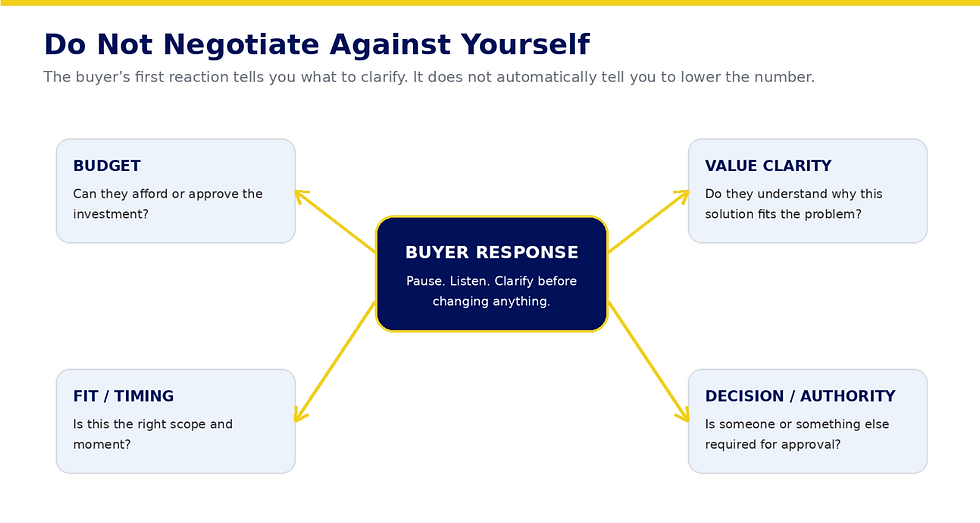

This is where price presentation ends and objection or decision work begins. If “let me think about it” appears, use the decision-stage article to identify whether the concern is informational, situational, financial, or something else. If the issue is price, diagnose it. Do not convert every question into a rebuttal.
A Worked Example: The Same $6,000 Price, Two Very Different Conversations
Assume a consultant has a defined eight-week engagement for a service business that has leads but no reliable sales follow-up process. The price has already been built from delivery economics and market evidence. The prospect is qualified and the consultant has diagnosed the breakdown.
Version One: The Provider Negotiates Against Herself
Provider: “So the program is $6,000. I know that might be higher than you were expecting, but there is a lot included. I do the CRM map, the follow-up emails, the sales process, and we have calls. I can probably split it up, and if that is still too much, I may be able to take something off.” |
Nothing in that response gave the buyer a chance to react. The provider created sticker shock, justified the price, introduced payment flexibility, and opened a discount conversation in one breath.
Version Two: The Provider Completes the Hand-Off
Provider: “Based on what we mapped today, I recommend the eight-week Sales Follow-Up Build because the issue is not lead generation. The break is what happens after an inquiry or discovery call. The investment is $6,000, with 50 percent due to begin and the balance due at the midpoint. We can start October 19 once the agreement and first payment are complete.” |
Then the provider stops talking.
Prospect: “That is more than I expected.” |
Provider: “Thanks for saying that. When you say more than expected, are you comparing it with a budget you had in mind, another service, or the scope you expected us to cover?” |
Now there is useful information to work with. Maybe the prospect had $3,000 available. Maybe they thought this was a strategy-only engagement. Maybe another consultant quoted $4,500. Maybe the number is fine but they need partner approval. Each answer creates a different business decision.
Presenting Price in a Proposal or Email
The same discipline applies when the price is written instead of spoken. Do not make a buyer hunt through a twelve-page proposal for the number. By the time they reach the investment section, the proposal should already have established the problem, recommended scope, responsibilities, and relevant terms.
Name the problem and desired result in language that matches the discovery conversation.
Recommend the specific scope rather than copying every service description from your website.
State the price, payment schedule, taxes or fees if applicable, and what is required to begin.
List assumptions, exclusions, revision limits, communication boundaries, or change-order rules that protect the scope.
Give the proposal a reasonable validity period when costs, schedule, or capacity can change.
Explain the acceptance path so the buyer knows exactly how to say yes.
Follow up on a defined schedule rather than sending the proposal into an inbox and hoping.
Written confidence looks like completeness. The buyer should not wonder which version of the price is real, when payment is due, what happens if scope changes, or who is responsible for the next action.
Practice the Sentence Before You Need the Sentence
The pricing moment feels heavier when you only practice it in front of someone who can reject you.
Say your price out loud when no money is on the table. Record yourself. Listen for speed, filler words, nervous laughter, upward inflection, unnecessary apologies, and spontaneous concessions. Then practice several buyer reactions so the first “that is more than I expected” does not send you scrambling for a new number.
Write the exact investment statement for each primary offer.
Write the approved payment options and the conditions for each.
Write the one or two scope reductions you are willing to make, if any.
Write what never changes without a new proposal or change order.
Practice a yes, a pause, a price question, a discount request, a “let me think,” and a no.
Debrief real conversations and update the language only when the evidence earns a change.
A framework protects the conversation because it lets you listen. You are not using brainpower to invent your price policy in real time.
Track the Price Moment Like a Sales Stage

One conversation can bruise your confidence. One enthusiastic yes can inflate it. Neither is a strategy.
Track enough conversations to see patterns. Start with the number of qualified prospects who received a recommendation and price. Then record what happened next: questions, objections, discounts requested, discounts given, decision time, outcome, and lost reason. Segment by offer and lead source when the buying context differs.
If one offer repeatedly requires unplanned discounting, the problem may be the price, the scope, the qualification, the recommendation, the proof, or the way value is being communicated. Use your sales conversion rate and the earlier stages of the sales process to diagnose the pattern rather than deciding you “just need more confidence.”
Common Pricing Presentation Mistakes

Complete a 30-Minute Price Presentation Review

Decision rule: Do not change price presentation language because one buyer paused. Change it when repeated qualified conversations show a pattern you can name and a correction you can test. |
Frequently Asked Questions About Presenting Your Price
Should I say “price,” “fee,” or “investment”?
Use the word that is natural and accurate for your business. “Investment” can fit coaching, consulting, and business services, but it does not create value by itself. Clarity matters more than choosing the most polished word.
Should I share pricing before a discovery call?
If the offer has a known price, starting investment, or meaningful range, sharing it before a lengthy sales process can improve fit and reduce surprise. For complex custom work, explain the range or paid discovery process rather than pretending the final scope is already known.
How do I sound confident if I still feel nervous?
Use preparation instead of trying to manufacture a feeling. Know the pricing logic, terms, boundaries, and recommendation criteria. Practice the investment statement aloud. Your body can feel nervous while your process remains clear.
What should I do if a prospect asks for a discount?
Clarify the reason first. If the issue is budget, decide whether a different scope or offer fits. If you give a concession, make it a deliberate business trade tied to scope, term, timing, or another real condition. Do not reduce the price and leave the work unchanged by reflex.
Should I stay silent after saying the price?
Give the buyer reasonable space to process. The point is not to create pressure. It is to avoid filling the pause with explanations and concessions before the buyer has responded.
What if the buyer says the price is too high?
Ask what they are comparing the price with and what specifically feels misaligned. The concern may be budget, expected scope, value clarity, timing, authority, or fit. Diagnose before you respond.
Should I offer multiple packages on the call?
Only when the options are genuinely appropriate. A recommendation is usually stronger than a menu. If two paths fit, explain how scope, access, speed, implementation responsibility, or support differs.
How do I know whether the price or my presentation is the problem?
Track qualified presentations, objections, discounts, close rate, decision time, and loss reasons by offer.
If qualified buyers consistently understand the value but cannot justify the price, revisit pricing or buyer fit. If the price changes from call to call or is buried in nervous explanation, fix the presentation system first.
Make the Price Sound Like a Business Fact
A price is not a confession. It is one term inside a business decision.
Do the diagnostic work. Recommend the right offer. Know why the number exists. State the investment and terms clearly. Let the buyer process. Then respond to what they actually say instead of negotiating with the fear in your own head.
You do not need to perform certainty. You need a business process strong enough that money does not make you abandon the structure you used for the rest of the conversation.
That is what confidence looks like in practice.
Find the weak stage in your sales process: Use the Sales Conversion Scorecard to review qualification, discovery, diagnosis, recommendation, pricing, objections, the close, follow-up, and measurement. If the scorecard is not yet live, explore Compass Mentoring for guided support building the complete sales process. |
About the Author
LaShay LaRue is the founder of Cherished Investments and a business coach, marketing strategist, and systems architect for service-based entrepreneurs. With more than a decade in business development, she helps coaches, consultants, creatives, and clinicians turn expertise into clear offers, sales funnels, and operating systems that support consistent growth. Her work is rooted in faith, service, stewardship, strategy, and the belief that a well-built business creates room for greater generosity and impact.


Comments