


How to Build an Email Nurture Sequencefor a Service Business

Sep 24
10 min read

If the only time your subscribers hear from you is when you have something to sell, you are not nurturing a relationship. You are ringing the register without greeting them at the door.
That pattern is common in service businesses. Someone downloads a guide, registers for a class, or requests information. The first email arrives. Then silence. Weeks later, a launch appears with urgency, bonuses, and a deadline. The business expects the subscriber to make a high-trust decision inside a relationship it never built.
I am a strong advocate for email marketing, but email is effective when the process behind it is effective.
In my ABCS framework, Build is the stage where a lead becomes a prospect through trust, relevance, and useful contact. The nurture sequence is one of the systems that makes that stage repeatable.
The goal is not to send more email for the sake of activity. The goal is to give the right person enough clarity to make the right next decision, even when that decision is not to buy today.
What an Email Nurture Sequence Actually Does
An email nurture sequence is an automated series triggered by a meaningful action. It welcomes the subscriber, continues the context of that action, helps them make progress, and guides them toward an appropriate next step.
That definition matters because not every group of emails is a nurture sequence. A welcome email delivers orientation. A newsletter maintains a recurring relationship. A launch campaign supports a time-bound offer. A nurture sequence connects a specific starting point to a clearer state of readiness.

Nurture sequence, newsletter, and launch campaign have different timing and jobs.
A healthy email program may use all three. The problem begins when a business treats them as interchangeable. A subscriber who requested a pricing checklist needs different follow-up from a client who just purchased, and both need different communication from the broader newsletter list.
The standard: The reader should be able to tell why this email is arriving, why the idea matters now, and what they can do next.
Use the TRUST Nurture Framework
I built the TRUST framework to keep nurture grounded in relationship instead of turning it into a string of disguised pitches. Each part has a distinct job, but the sequence should still read like one thoughtful conversation.

The TRUST framework: Trigger, Relate, Usefully Teach, Show, and Transition.
T: Trigger With Context
Begin with what the subscriber just did. If they downloaded a resource, name it and deliver it. If they attended an event, reference the idea or decision that brought them there. If they requested a call, prepare them for that conversation. Context is what makes automation feel attentive.
The first message should confirm the exchange, set expectations, and create a small next action. Tell the reader what they will receive, how often they should expect to hear from you, and how to reply or manage preferences. Do not make them search for the thing you promised.
Welcome email opening: You requested [resource] because [specific decision or problem] is probably on your mind. Here is the resource. Start with [one section or action], because it will help you [immediate benefit]. Over the next [timeframe], I will send a few short emails to help you use it and decide what should come next.
R: Relate to the Real Problem
The item someone requested tells you what caught their attention. It does not always reveal the larger issue. Your next job is to connect the immediate request to the deeper business problem without manufacturing fear.
A content calendar download may point to an idea problem, but it may also reveal that the owner has no connection between content and offers. A discovery-call checklist may point to nervousness, but the deeper issue may be an unclear service statement or sales process. Relating means naming the pattern accurately enough that the subscriber feels understood and can evaluate it for themselves.
U: Usefully Teach One Decision
Do not turn each email into a miniature course. Teach one decision, one distinction, or one action. The reader should be able to use the message without blocking an afternoon to study it.
Useful teaching can take several forms: a three-question diagnostic, a short checklist, a before-and-after contrast, a mistake to avoid, a template, or a simple experiment. The strongest lesson creates movement and also demonstrates how you think.
That last part is important. People do not hire a service provider only because the information is correct. They hire because they trust the provider's judgment, process, and ability to apply that information to a real situation.
S: Show Proof and Perspective
Proof does not have to mean a dramatic revenue screenshot. Show the work. Explain the process you used, the decision that changed, the pattern you noticed, or the lesson a client taught you. Use examples that protect confidentiality and match the claim you are making.
Perspective is the part another business cannot simply copy and claim as its own. It can come from your experience, your standards, your values, or the way you connect ideas. For me, nurture is stewardship. Someone gave you access to their inbox. The responsibility is to use that access with care and purpose.
T: Transition to the Next Step
A nurture sequence should not hide the fact that you run a business. Soft selling does not mean making the paid offer invisible. It means the invitation is relevant, honest, and proportional to the trust and readiness that exist.
The transition can be a reply, assessment, event, consultation, application, paid diagnostic, or direct purchase. State who the next step is for, what it helps them decide or accomplish, and what happens after they act. A clear invitation reduces pressure because it gives the reader enough information to make a clean choice.
If your offer still sounds like a list of tasks, strengthen it with how to build offers around outcomes instead of deliverables and clarify the promise with how to write a service statement that sells.
Map the Sequence Before You Write It
Writing becomes much easier when the strategy is already decided. Before drafting subject lines, map the path on one page.

The trigger should connect to the rest of the funnel. If the free resource is still operating as a disconnected download, begin with how to turn your free resource into a funnel.
A Seven-Email Nurture Sequence You Can Adapt
Seven emails are enough to build a practical starter sequence without pretending there is one perfect length for every offer. A high-trust, high-price, or complex decision may need ongoing nurture beyond this sequence. The order matters more than a rigid schedule.

Seven-email starter sequence: Welcome, Quick Win, Diagnose, Reframe, Demonstrate, De-risk, and Invite.

The timing is a starting point, not a commandment. A time-sensitive workshop may need a tighter sequence. A considered advisory offer may need more space. Use urgency, complexity, price, buyer risk, and normal buying behavior to choose the cadence.
Do not automate over a decision: If a subscriber books, buys, applies, or enters a sales conversation, remove them from messages that no longer fit. Automation should protect context, not bulldoze it.
Write Each Email Around One Useful Move
A clear nurture email does not need a complicated copy formula. It needs a coherent job. Use this structure as a writing check, not a rigid template.

Keep paragraphs short enough for a phone. Use descriptive link text. Make buttons and linked text easy to tap. Add alternative text to meaningful images and do not place essential information only inside an image. The plain-text meaning should survive even when images do not load.
Write Subject Lines That Respect the Inbox
A subject line earns the open by creating accurate relevance. It should reflect the actual content, not manufacture drama. Curiosity can help, but clarity must still win.

Preview text should extend the subject instead of repeating it. If the subject is 'A ten-minute way to find the gap,' the preview might say, 'Start with the point where a lead stops knowing what happens next.'
Segment the Relationship, Not Just the List
You do not need 40 complicated segments to get started. You do need enough context to avoid sending everyone the same message. At minimum, preserve the source, resource or event, offer interest, customer-journey stage, and meaningful actions such as booking, buying, replying, or clicking a high-intent page.

Route nurture by the action the subscriber just took.
A tag is only useful when it changes what happens next. Do not collect labels because the platform allows it. Decide the routing rule, owner, message, and exit condition for each tag you create.
Align the sequence with the decision stage using how to connect every content type to the buyer journey. A person learning that a problem exists should not receive the same invitation as a person comparing providers.
Keep the Personal Touch Without Writing Every Email Live
Automation is not the opposite of personal. Irrelevance is. A well-planned sequence can feel more attentive than a rushed message written from memory three weeks late.
Use details that are true and useful: what the person requested, the challenge it addresses, a lesson from your work, and an honest invitation to reply. Write the way you speak when you are helping one capable person make a decision. Remove filler greetings, manufactured intimacy, and false one-to-one language.
Then create openings for real conversation. Ask a question you genuinely want answered. Monitor replies. Route qualified responses to a human. Save the language people use, because their questions can improve the sequence, offer, content, and sales process.
What Happens After the Automated Sequence
The end of the sequence is not the end of the relationship. Subscribers who do not take the paid next step can move into an ongoing nurture rhythm that teaches, interprets, demonstrates, converses, and occasionally invites.

A couple of useful emails a month can be more effective than disappearing and returning only when you need revenue. Choose a rhythm you can sustain and improve.
Build the System Behind the Sequence
Your email platform should be able to capture permission, apply tags or fields, trigger the right sequence, pause or exit people when their status changes, and record useful actions. Your business also needs a sending domain, authenticated email, a monitored reply address, current links, and an owner for maintenance.

Protect Deliverability and Permission
Good writing cannot rescue a list that did not consent, a domain that is not authenticated, or a sequence that makes it difficult to leave. Use an email service provider and configure the sending domain correctly. For Gmail recipients, current sender guidance requires authentication, and higher-volume senders face additional SPF, DKIM, DMARC, one-click unsubscribe, spam-rate, and message-format requirements. Confirm the requirements that apply to your volume and platform.
For U.S. commercial email, the CAN-SPAM Act applies beyond classic bulk email. The Federal Trade Commission requires accurate header information and subject lines, a valid physical postal address, a clear opt-out method, and prompt handling of opt-out requests. Other countries and states may require prior consent, specific records, or additional rights. Get qualified legal advice for your business and audience.
Make it easy to unsubscribe. Remove hard bounces. Review inactive contacts carefully. Never buy a list and drop strangers into a nurture sequence. Permission is not a technical checkbox. It is the beginning of trust.
Measure Movement, Not Vanity
Open rate can still offer directional information, but it is not a clean count of human attention. Apple Mail Privacy Protection prevents senders from seeing whether protected users opened a message, and other automated activity can also affect tracking. Use opens carefully and pair them with stronger actions.
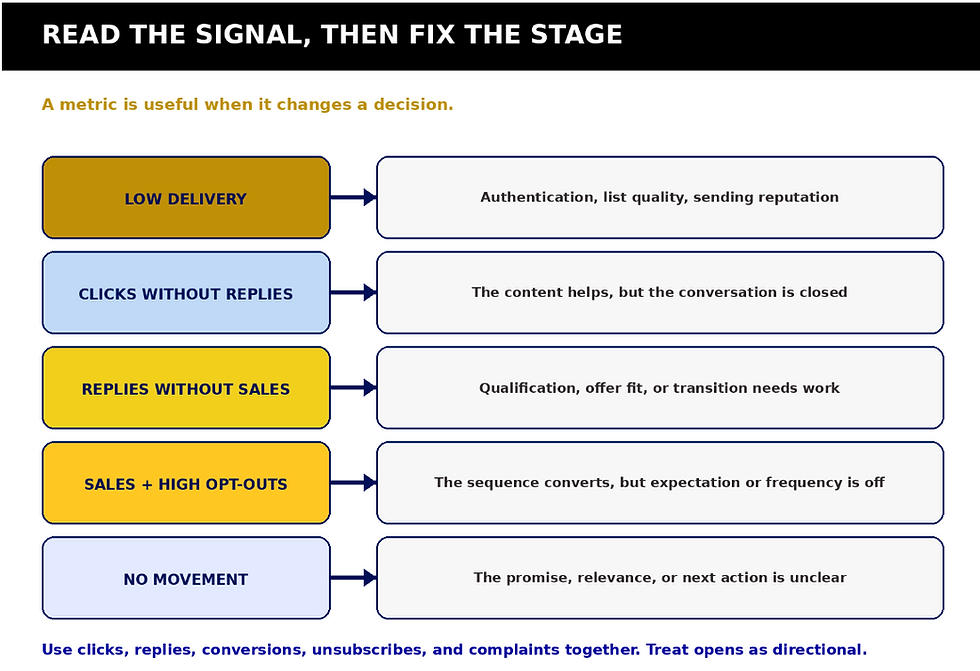
Use combined email signals to diagnose the stage that needs attention.

Read the pattern by email and by segment. If clicks fall after email three, inspect the transition between emails two and three. If replies are strong but no qualified opportunities emerge, the content may be relevant to the wrong audience or the offer connection may be weak.
Preserve the original source and connect the sequence to client outcomes. Use how to track lead sources and client acquisition results and how to track funnel conversion at every stage to build the full measurement path.
Common Email Nurture Mistakes

Four Service-Business Examples

The content changes, but the sequence logic stays consistent: preserve context, create a useful win, deepen the diagnosis, show a credible method, reduce risk, and make the next step clear.
Build Your First Sequence in Seven Focused Days

Before you activate it: Read every email in sequence on a phone. Confirm the resource, subject, preview text, From name, reply address, links, tags, delays, booking path, purchase exit, unsubscribe control, and final destination. Then ask one question: does this feel like a guided relationship or a stack of campaigns?
Frequently Asked Questions About Email Nurture Sequences
What is an email nurture sequence?
An email nurture sequence is an automated series triggered by a meaningful action. It continues the subscriber's context, delivers useful guidance, builds trust, and leads toward an appropriate next decision.
How many emails should a nurture sequence include?
There is no universal number. Seven emails create a strong starter path, but complex or high-trust offers may need longer sequences and ongoing nurture. Each email should have a distinct job.
How often should nurture emails be sent?
Match the cadence to urgency, complexity, price, buyer risk, and expectations. A starter sequence may run over 10 to 14 days, while a time-sensitive event may be tighter and a considered advisory offer may be slower.
What is the difference between a welcome sequence and a nurture sequence?
A welcome sequence mainly delivers, orients, and sets expectations. A nurture sequence goes further by deepening relevance, teaching decisions, showing proof, reducing risk, and transitioning to a next step.
Should every nurture email include a sales call to action?
No. Every email should include a useful next action, but that action may be to apply an idea, read a resource, reply, or inspect a problem. Make the paid invitation when it is relevant and clear.
Can the same nurture sequence serve every lead magnet?
Only when the trigger, audience, problem, and next step genuinely align. Different resources usually signal different context and should receive at least a tailored opening and routing.
What should I track besides open rate?
Track delivery, clicks, replies, sequence completion, qualified next-step actions, clients, revenue, unsubscribes, complaints, and results by source and segment. Treat opens as directional rather than definitive.
When should someone leave the sequence?
Exit or reroute someone when they buy, book, apply, opt out, bounce, enter a client workflow, or take another action that makes the remaining messages irrelevant.
Build the Relationship Before You Need the Revenue
A nurture sequence is not a trick for warming up a list. It is a system for showing up with enough consistency, relevance, and clarity that the right person can recognize the value of continuing with you.
Preserve the context. Teach something useful. Show how you think. Make room for conversation. Invite honestly. Measure what moves. That is how automation supports trust instead of replacing it.

Email nurture sits in the Build stage of the ABCS journey and prepares qualified subscribers to Convert.
See thoughtful email nurture in practice: Get the Monthly Trend Report. It is designed to help service-based entrepreneurs understand meaningful shifts without chasing every headline. Use the insight for your business, and pay attention to the experience around it: the promise, delivery, relevance, follow-up, and next step.
About the Author
LaShay LaRue is the founder of Cherished Investments and a business coach, marketing strategist, and systems architect. With more than a decade in business development, she helps service-based entrepreneurs turn expertise into clear offers, client journeys, nurture systems, and operating infrastructure. Her work is rooted in faith, service, strategy, generosity, and lasting impact.


Comments