


The Business Relationships That Help You Stop Guessing and Start Growing

May 13
8 min read
There is a decision you have been sitting on for weeks. Maybe it is about pricing. Maybe it is about whether to fire a client who drains your energy but pays consistently. Maybe it is about restructuring your offer, pivoting your niche, or finally investing in something that scares you. You have turned it over in your head a hundred times. You have made a pros-and-cons list. You have asked your partner or your best friend, and their advice was kind but not useful because they do not understand the specifics of what you are building.
So the decision sits. And while it sits, your business stays exactly where it is.
That is not a mindset problem. That is not a confidence problem. That is an infrastructure problem. You are missing the people who can see what you cannot see, challenge what you refuse to question, and tell you what you need to hear instead of what you want to hear. And the absence of those people is not just slowing you down emotionally. It is costing you strategically.
The Real Cost of Making Decisions in Isolation
Isolation does not just feel bad. It produces bad decisions.
Without external perspective, you optimize for comfort instead of growth. You avoid the hard conversation with the client who is not a fit. You keep the pricing you set two years ago because raising it feels risky and nobody is pushing you to reconsider. You stay on one platform because expanding to another feels overwhelming, and there is no one in your corner saying, "Here is how to do it without doubling your workload."
Your friends and family care about you. But most of them do not understand the specific pressures of running a service-based business. They cannot tell you whether your discovery call process has gaps or whether your email sequence is converting below benchmark. Asking them for strategic business advice is like asking your dentist about your plumbing. The intention is good. The expertise is not there.
Here is what the research consistently shows about coaching and consulting businesses specifically. The strongest acquisition channels for service-based entrepreneurs, including referral partnerships, peer-led trust transfer, and collaborative visibility, all depend on relationships. Referrals require a relationship with someone who trusts you enough to put their reputation behind yours. Strategic partnerships require a relationship with someone whose audience overlaps with yours. And the fastest-growing entrepreneurs are not the smartest ones in the room. They are the ones with the shortest feedback loops. A mentor, a peer group, or a strategic partner gives you that loop.

Three Types of Relationships Every Business Owner Needs
Not all professional relationships are created equal. And the vague advice to "build your network" is useless without a framework for what to build and why. Here are the three types of relationships that create measurable impact on your revenue, your decision-making, and your growth trajectory.
The Mentor: Someone who has already solved the problem you are stuck on.
A mentor is not a celebrity you follow on Instagram. A mentor is someone further ahead in business who is willing to be honest, strategic, and specific with you. They do not need to be famous. They need to have solved the problem you are currently facing and be willing to share how.
The value of a mentor is speed. They compress time. A problem you would spend three months circling, a good mentor can help you resolve in one conversation because they have already navigated it. They see the patterns you are too close to recognize. They challenge the assumptions you have stopped questioning. And they hold you accountable to the plan instead of letting you drift.
What a mentor solves: the vision problem. When you cannot see the next step clearly, a mentor who has already taken that step can show you the path without making the decision for you.
The Peer Group: Two to five people at your level who meet with intention.
A peer group is not a networking event. It is not a Facebook group you scroll through passively. It is two to five people at a similar stage of business who meet regularly, with a structure, to share real challenges, real numbers, and real accountability.
The value of a peer group is perspective. When you are inside your own business, you lose the ability to see it objectively. A peer group gives you five sets of eyes that are not emotionally attached to your decisions. They can say, "That pricing does not match the value you deliver" or "Your onboarding process has a gap you are not seeing" because they are close enough to understand but far enough to be honest.
The best peer groups have three elements. A regular meeting cadence, whether weekly, bi-weekly, or monthly. A format for sharing wins and challenges, not a free-for-all conversation. And a commitment to confidentiality, because vulnerability requires safety.
What a peer group solves: the isolation problem. You stop carrying the weight of every decision alone, and you gain a room of people who understand what you are building because they are building something similar.
The Strategic Partner: Someone whose audience overlaps with yours but whose offer does not compete.
A strategic partner is the most underused growth lever in service-based businesses. This is someone who serves the same audience you do, with a different expertise. A business coach and a brand designer. A marketing strategist and a web developer. A leadership coach and a therapist. The partnership works because you make each other more valuable to your shared audience.
The value of a strategic partner is reach without effort. When a trusted peer recommends you to their audience, the trust transfers. That referral carries more weight than any ad, any social media post, or any cold outreach because it comes from someone the prospect already believes in.
Research on coaching business acquisition supports this directly. Partner-led and event-led strategies work for coaching because the sale depends on trust transfer. The person recommending you is lending their credibility. And credibility, once lent, converts at a rate no marketing campaign can match.
What a strategic partner solves: the reach problem. You get in front of the right audience without building that audience from scratch, because someone else has already built the trust for you.
How to Find and Build These Relationships With Intention
Knowing you need these relationships and actually building them are two different problems. Here is how to approach each one without it feeling forced, transactional, or uncomfortable.
Finding a mentor.
Do not cold-DM someone and ask them to mentor you. That is not how mentorship works. Mentorship is earned through relationship, not requested through a message.
Start by engaging with their content consistently. Not generic comments. Thoughtful engagement that shows you are paying attention and applying what they teach. Attend their events. Invest in their programs if the fit is right. Demonstrate through your actions that you are serious, coachable, and doing the work. Mentorship develops when the mentor sees someone they want to invest in, not when a stranger asks for free access to their expertise.
And here is the part most people skip: mentorship can be paid. Hiring a mentor or joining a mentoring program is not a lesser version of mentorship. It is often the most effective version because the structure, accountability, and access are built in from the start.
Building a peer group.
Look for people who are willing to be honest, not just supportive. The entrepreneurs who only tell you "you are doing great" when your business is stalling are not peers. They are cheerleaders. Cheerleaders are nice to have. They are not who you need in the room when you are making hard decisions.
Start with one person. Someone you have connected with in a community, at an event, or through a program. Suggest a monthly call. Keep it structured: each person gets 15 minutes to share their biggest challenge and receive feedback. If it works, add one or two more people. Keep the group small. Intimacy creates honesty. Honesty creates growth.
Identifying a strategic partner.
Look for someone whose audience overlaps with yours but whose offer does not compete. A simple way to find them: ask yourself, "Who are my clients hiring before they hire me? Who are they hiring after?" Those businesses are your natural partners.
Start with a conversation, not a proposal. Share what you do, learn what they do, and explore whether there is a natural overlap. If there is, start small: share each other's content, refer one client each way, or co-host a live session. Do not launch a full partnership strategy on day one. Let the relationship prove itself before you build infrastructure around it.
What Good Mentorship Actually Looks Like (And What It Does Not)
Because this is the part that gets romanticized and misunderstood more than any other.
Good mentorship is strategic, structured, and honest. It involves regular check-ins, clear guidance, and someone who tells you when you are wrong. It is not comfortable all the time. The mentor who makes you squirm during a conversation about your pricing or your boundaries is the one doing the most important work.
Good mentorship is not free advice on demand. It is not someone who tells you what you want to hear to keep the relationship pleasant. And it is not a parasocial relationship where you consume their content, feel inspired, and call it mentorship. That is entertainment. It might be educational entertainment. But it is not mentorship.
Investing in mentorship is a business decision, not a luxury. The ROI of the right mentor shows up in faster decisions, avoided mistakes, and strategic clarity that saves months of guessing. Think about the decision you have been sitting on for weeks. A single conversation with the right mentor could resolve it today. What is that worth compared to another month of indecision?
The shift is this: you are not looking for someone to inspire you. You are looking for someone to challenge you, structure your thinking, and hold you accountable to the plan. That is not a guru. That is a partner in your growth.
The Connection Between Relationships and Revenue
This post has been about relationships. But make no mistake: this is a revenue conversation.
The mentor who helps you raise your pricing by 20 percent has directly increased your revenue. The peer group that catches a gap in your client experience has directly prevented lost renewals. The strategic partner who refers three qualified clients has directly shortened your sales cycle. These are not soft skills. These are business infrastructure.
Over the past two weeks, you audited your client experience, diagnosed your funnel, and optimized your email sequence. Every one of those exercises would have been sharper, faster, and more effective with outside perspective. The client experience audit reveals gaps, but a mentor sees the ones you have normalized. The funnel diagnosis identifies the weak link, but a peer group challenges whether you are measuring the right metrics. The email optimization improves conversions, but a strategic partner introduces you to an audience that is already warm.
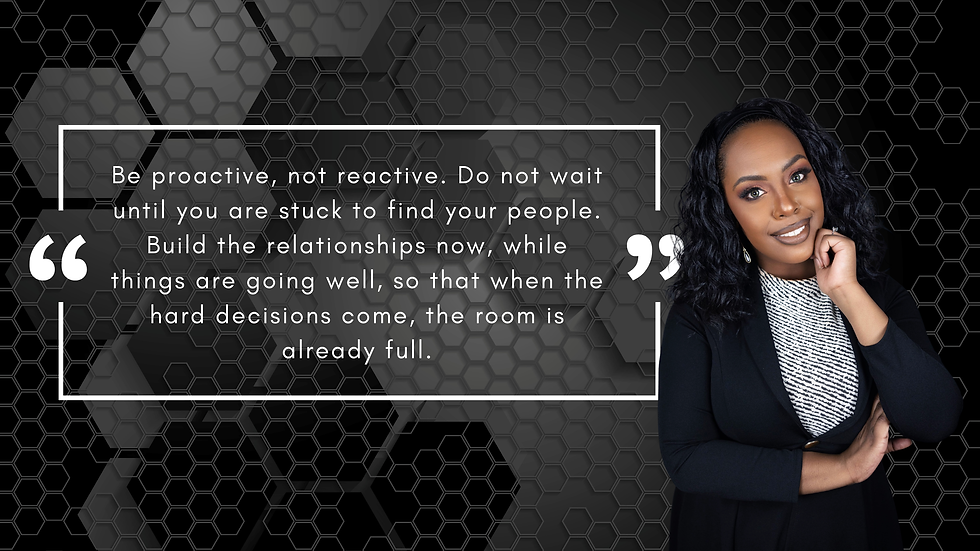
Be proactive, not reactive. Do not wait until you are stuck to find your people. Build the relationships now, while things are going well, so that when the hard decisions come, the room is already full.
Stop Building Alone
You are not meant to build this alone. That is not a motivational statement. It is a strategic one.
The decisions you are avoiding. The growth you are stalling. The confidence you are missing. Most of it traces back to not having the right people in your corner. Not people who cheer for you. People who sharpen you. People who say, "Your pricing is too low and here is the data to prove it." People who say, "Your onboarding has a gap and here is how to close it." People who say, "I tried that same approach and it did not work. Here is what I did instead."
Find one person this month. Not a follower. Not a fan. A partner, a peer, or a mentor who will tell you what you need to hear and help you act on it. That one relationship will produce more progress than another month of doing it all yourself.
If this post landed and you realized the room you have been building in is too quiet, that is not a problem. That is a signal.
The SBA Success Network is a free community of service-based entrepreneurs who are building with intention, not in isolation. It is where business owners share what is actually happening in their business, ask the questions they are afraid to ask publicly, and get honest feedback from people who understand the weight of building something from scratch.
It is not a networking group. It is the beginning of the peer circle this post just described.


Comments